Showing posts with label opera theatre of st. louis. Show all posts

Sunday, June 21, 2015

Singing as Olympic sport in Opera Theatre's "Richard the Lionheart"

Tim Meady
Photo: Ken Howard
If you're in the mood for an evening of singing so incredible that you'll wonder why it isn't an Olympic sport, then allow me to recommend Opera Theatre's production of the American premiere of Handel's "Richard the Lionheart" (original Italian title: "Riccardo primo, re d’Inghilterra"), final performances of which are this Wednesday at Friday at 8 at the Loretto-Hilton Center on the Webster University campus.

Written in London (where Handel's Italian-language historical operas were all the rage) for the Royal Academy of Music's 1726/27 season, "Richard" was intended, in part, as a celebratory work for the coronation of England's King George II. As a result it turns England's feckless Crusader king into an absurdly noble romantic figure and suffers (in my view) from an overdose of English Jingoism in its final act.

Yes, that’s right: an opera written in Italian by a German-born composer celebrates the English virtues of George II, a German-born King. It’s enough to make your head spin.

One other thing that might make your head spin if you're not an opera and/or classical music fan is that fact that the male leads in "Richard the Lionheart" (Richard and the Syrian prince Oronte) are sung not by tenors but by countertenors—men who sing in the mezzo-soprano or alto range. That's because in Handel's day it was fashionable for these parts to be sung by castrati—male singers who were castrated before puberty and whose voices, therefore, never dropped in pitch.

Handel had a couple of the great castrati of his era to work with in this opera, so Richard and Oronte's arias are flashy and absurdly difficult, filled with elaborate, rapid passages and florid ornamentation. Opera Theatre has, happily, two fine singers in the roles: Tim Mead as Richard and Tai Oney as Oronte. Mr. Mead is clearly the stronger of the two, with a powerful, wide-ranging voice and a convincingly forceful stage presence, although Mr. Oney is no slouch. Their respective calls to arms in the third act are a highlight.

The story of the opera is based on a real incident in 1191 in which Richard's fiancée, Berengaria of Navarre, was shipwrecked off the coast of Cyprus and held hostage by the island's ruler, Isaac Komnenos. Richard conquered the island and got her back. The opera changes Berengaria's name to Costanza and adds a subplot in which Isaac (Isacio in the opera) tries to pass off his daughter Pulcheria as Richard's intended, much to the distress of Pulcheria's lover Oronte.

L-R: Susannah Biller and Devon Guthrie
Photo: Ken Howard
It's silly stuff and stage director Lee Blakeley has tacked on an unconvincingly dark ending that flatly contradicts the text and the music, but nothing can detract from the fine singing and acting of this cast.

I've already praised Mr. Mead and Mr. Oney. Soprano Susannah Biller has a crystal-clear coloratura that navigates the music with ease, while soprano Devon Guthrie has an equally impressive but darker tone that works well for Pulcheria. Bass-baritone Brandon Cedel radiates menace as Isacio and bass Adam Lau is warmly sympathetic as Costanza's cousin Berardo. Both have formidable voices that project well.

Grant Llewellyn conducts the appropriately small orchestra with great flair and sensitivity. Their playing is perfection, with shout-outs to Laura Osterlund on sopranino recorder for her wonderful work on Costanza's "swallow" aria, and to Simon Martyn-Ellis, whose archlute adds a nice bite to the continuo part played by Damien Francoeur-Krzyzek on harpsichord and Melissa Brooks on 'cello.

For the full Opera Theatre experience, come early and have a picnic or a drink on a table on the lawn. For details on "Richard the Lionheart" and the other three operas this season, visit the company web site.

This review originally appeared at 88.1 KDHX, where Chuck Lavazzi is the senior performing arts critic.

Friday, June 12, 2015

Opera Preview: An e-chat with James Robinson, director of "Emmeline" at Opera Theatre

James Robinson
experienceopera.org
Opera Theatre's fourth production of the season is the local premiere of Tobias Picker's 1996 "Emmeline," which has a book by poet J.D. McClatchy, based on the novel of the same name by Judith Rossner. I spoke with stage director James Robinson about the piece via email this week.

Chuck Lavazzi: "Emmeline" is the story of a young textile mill worker who is seduced by her employer's son-in-law, gets pregnant, and is forced to give up the baby. Two decades later she unwittingly meets and marries the young man who turns out to be her son. That kernel of story, it seems to me, resonates on both a deep psychological level with its overtones of Oedipus as well as on a political and social level. What aspects of the opera do you find most compelling and why?

James Robinson: I've always been drawn to stories about "the other" in a society. "Emmeline" is certainly about someone who through no fault of her own has become a pariah, an outcast. It's certainly a deeply psychological story that has strong ties to "Oedipus," but it's also the tale of a woman who is really looking and longing to be loved. Obviously, she is taken advantage of by McGuire, the employer's son-in-law who not just takes advantage of her and, to be blunt, he rapes her. McGuire knows that young Emmeline, who has just come to work in the mills, is lonely and he suggests that he can become a father figure to her (knowing that she desperately misses her father and family). What's masterful about the way McClatchy and Picker have approached this situation is that the audience is almost fooled into believing this is a traditional romantic situation — the text is like a love duet and the music is achingly romantic. Then you have to say, "Wait a minute, she's 14 and he's at least twice her age!" Of course, when she finally falls in love with Matthew we again are hoping that she finds true love. Again, it turns out very badly and both librettist and composer know how to deliver a real punch in the gut. So I think these elements are really interesting. In a sense, "Emmeline" with its taut libretto and stunning music is like an opera by Janacek. It follows that composer's masterworks like "Katya Kabanova" and "Jenufa".

I guess on another level, I love the fact that this is an American opera set in New England and it's rooted in a real time and place. Historically, the mills of Lowell, MA were fascinating in terms of the girls who were sent to work there and what it meant — both good and bad — to industry in the US. I also enjoy presenting operas that shed light on times and places that are not commonly familiar to most people.

Speaking of the music, in the New York Times review of the 1998 City Opera production, Bernard Holland (who liked the score quite a lot) wrote that the composer "has a true ear for lyrical run-on musical sentences. They ride gracefully and take interesting directions." I'm not entirely sure what he means by that. Now that you've spend so much time with the music, and you tell me what you think he was getting at there?

I would say that Picker has written some really wonderful lyrical passages that are not entirely predictable. "Emmeline" is a very tuneful score and the vocal writing plays off of a lot of solo writing in the orchestra. I would say it's one of the great strengths of the piece because you never really know where the lines are going. So in a sense it's very much like the way people speak or think — there's a great deal of spontaneity that keeps you wondering where things are heading. This as opposed to a more formulaic pattern of vocal writing.

It sounds like even though Picker studied with some aggressively "modernist" composers like Elliott Carter and Milton Babbitt, he has personally gone back to a more tonal style of composition. Is this something you see happening frequently in the contemporary opera world?

Interestingly, I have come across many composers who worked with some hardcore modernists over the years but who have opted to compose in a more lyrical even tonal style. There is a rigorous element to Picker's music that certainly reflects some of his earlier compositions but I think this has less to do with atonality and more to do with rhythm. "Emmeline" is, in fact, an extremely tonal score but there are some extremely complex rhythmic patterns used throughout.

Yes, I think something similar is happening in the concert world as well. I've been hearing a lot of "new music" lately that seems to recognize that the war against tonality that the serialists started has been lost. That's a positive development in my book.

I've seen the same thing. I'm not sure it's a complete rejection of brutal atonality as many of these newer/younger composers are employing certain techniques but in a more personal way and with music rooted in tonality. There's also a lot of fusion of styles that I think is very interesting. You hear influences of jazz, rock and international music. The real pros know how to bring these things together to create their own voices.

Last question: "Emmeline" is, as you say, a layered and complex piece. What are you hoping audiences will take away from it, emotionally and/or intellectually?

I'm hoping the audiences for "Emmeline" will find it a riveting story with really gorgeous music (and terrific performances). True, it's a dark story but it's also quite a moving story that resonates on so many levels. Someone I know saw a dress rehearsal (and she's not a huge opera fan) and wrote me the most incredible note about how the opera touched her deeply on levels of love, religion, passion, taking advantage of children, etc. Is the story too dark? I don't think so. After all, we know pretty early on that Cio Cio San, Mimi and Tosca are not going to have an easy time of it.

"Emmeline" opens Sunday, June 14, and runs through June 27. For more information, visit the Opera Theatre web site.

Wednesday, June 3, 2015

Puccini's music and Opera Theatre's performers star in "La Rondine"

Act II quartet and chorus
Photo: Ken Howard
Puccini’s romantic drama "La Rondine" was something of a problem child for the composer. Opera Theatre's utterly splendid production of the original 1917 version (there are thee altogether) illustrates the issue: Giuseppe Adami's clunker of a libretto. As beautifully sung, impeccably acted, intelligently directed, and generally entertaining as this "La Rondine" is, there's just no getting around those words.

The opera's history was troubled from the beginning. The original request from Vienna's Carltheater in 1913 was for an operetta. Puccini asked for (and got) permission to instead write a genuine opera, but lighter in tone than his tragic masterpieces. When he offered the finished product to his publisher Tito Ricordi in 1916, Ricordi turned it down. Yet when it was published by Ricordi's rival Lorenzo Sonzogno, Ricordi (as stage director Michael Gieleta relates in his program notes) "spread bad word of mouth about 'La rondine'...with such zeal that even a century later, both experts and amateurs retains all sorts of 'opinions' on what 'La rondine' was and wasn't."

Sydney Mancasola and John McVeigh
Photo: Ken Howard
It was revised twice after its premiere (the final version was mounted by OTSL back in 1996), but no revision of it has ever achieved the popularity of "La Boheme" (which it somewhat resembles, at least in the second act) or Puccini's other operas. Until very recently it was still not uncommon to see it dismissed as "Puccini's operetta."

In both the first and third versions, the libretto of "La Rondine" is often so cryptic that it's nearly telegraphic. "We are given minimal background information concerning the characters," observed Mr. Gieleta in an interview with me during tech week, "as if the piece was prompting the audience to figure the actual storyline out for themselves from the scraps of textual evidence. In that context, La Rondine is reminiscent of a good theatrical play in which the author renounces traditional omniscience and where the public is free to interpret the scarcely narrated facts in their own way." Unfortunately, it also makes some of the characters' decisions a bit baffling.

The story is basically “Traviata lite”. Magda, a “kept woman”, leaves her rich, middle-aged lover Rambaldo and her lush life in Paris to take up with Ruggero, a young hunk from the sticks. Unfortunately the young hunk is, as written, far too painfully naive to be sympathetic, and the rich lover little more than a cipher, which makes Magda's decision to leave them both seem more immature and petulant than tragic.

Corinne Winters
Photo: Ken Howard
That said, this is such an impressive production in every way that I mostly found myself able to suspend disbelief and revel in the many wonderful individual moments. The ecstatic "toast to love" in the second act, with the full chorus in full voice, is but one of many examples. One does not, in the final analysis, go to a Puccini opera for the intelligence of the libretto but for the emotional power of the music. And "La Rondine" has that in abundance.

This production also has bravura performances in abundance, led by soprano Corinne Winters as Magda. She has, in her lower register, the kind of richness I associate with mezzos or altos, while still retaining a crystal clear head voice. Her first big aria in Act I ("Chi il bel sogno di Doretta" in the original Italian) was a real show stopper, drawing enthusiastic applause from the opening night audience. Better yet, her acting is completely convincing, even in the drawn-out melodramatic renunciation of Ruggero in the third act.

As Magda's maid Lisette, whose expectations of music-hall stardom prove to be wildly unrealistic, soprano Sydney Mancasola also displays a wonderfully clear voice with great top notes, along with a sure comic sense. Tenor John McVeigh turns in an equally fine performance as the poet Prunier, Lisette's on again/off again lover, with yet another fine, strong voice and a convincingly sympathetic character.

Corinne Winters and Anthony Kalil
Photo: Ken Howard
In the role of Ruggero, tenor Anthony Kalil did not sound as vocally powerful to me as the rest of the principals, but otherwise turned in a respectable if somewhat monochromatic performance. There is, I think, a bit more variety to Ruggero's character than I saw, at least on opening night. Still, he certainly holds his own with Ms. Winters, Ms. Mancasola, and Mr. McVeigh in that rapturous quartet-and-chorus number in the second act.

Bass-baritone Matthew Burns isn't given much to do as Rambaldo, but even so he manages to suggest that there is more to his character than the libretto indicates, and does so with a robust and well-focused voice. Sopranos Ashley Milanese and Elizabeth Sutphen and mezzo Hannah Hagerty all provide well-sung cameos as Magda's friends Yvette, Bianca, and Suzy.

Mr. Gieleta direction is unfailingly sure-footed, creating powerful stage pictures, clarifying character, and generally serving the material remarkably well. Alexander Dodge's and Gregory Gale's costumes beautifully conjure up both Belle Époque Paris and the seaside resort to which Magda and Ruggero flee in the third act, assisted by Christopher Akerlind's dramatic lighting design. This is a "La Rondine" that looks as good as it sounds.

John McVeigh, Corinne Winters and ensemble
Photo: Ken Howard
Speaking of how it sounds, OTSL Music Director Stephen Lord conducts the orchestra with the assurance we have come to expect of him over the years, while the ensemble of (mostly) St. Louis Symphony musicians responds with powerful, impeccable playing. Puccini's entrancing score comes through in all its glory.

"La Rondine" may never get as much respect as Puccini's more famous works, but it deserves to be seen, if only because it's one of the few Puccini operas in which the heroine isn't either a hapless victim or clueless enabler of badly-behaved men. Say what you will about Magda, she ultimately chooses her own road, even if her reasons are not always clear. And when her story is told this well—to say nothing of this beautifully sung—it’s a reminder of why we love opera in the first place.

The Opera Theatre of St. Louis production of "La Rondine" continues through June 28 in rotating repertory with three other operas at the Loretto-Hilton Center on the Webster University campus. More information is available at the opera theatre web site.

This review originally appeared at 88.1 KDHX, where Chuck Lavazzi is the senior performing arts critic.

Wednesday, May 27, 2015

Opera Preview: OTSL's MIchael Gieleta on the modermism of Puccini's 'La Rondine'

Michael Gieleta
michaelgieleta.com
This Saturday, May 30th, Opera Theatre of St. Louis presents Puccini's rarely seen "lyrical comedy" "La Rondine" ("The Swallow") in the original 1917 version. The opera has only been seen once before on the OTSL stage—in 1996, when the company presented the American premiere of the third (1921) version. I interviewed stage director Michael Gieleta via email during the final week of rehearsals.

Chuck Lavazzi: Puccini famously left "La Rondine" in a bit of a mess when he died, with three different performing versions available. OTSL has decided on the original 1917 version, which seems to be a popular choice. What were the factors the led you and your collaborators to pick this one as opposed to the other two?

Michael Gieleta: I don't think Puccini's lateral takes on "La Rondine" are any different from his takes on "Madama Butterfly," or of many now-famous American musicals which, for different reasons, get written and rewritten before, during and after they reach Broadway/the West End. It's not untypical of the composers' creative process and of its response to the various kind of pressure from the publishers, producers and the initial press feedback. Lastly, there are the stars who demand an extra "number" (be it "Send in the Clowns" or "Una furtiva lagrima") before the final curtain. Does anyone ever perform the Berlin version of Ibsen's "Doll's House" at the end of which Nora decides to stay with the husband and the children in order to keep the family hearth alit?

OTSL considered the original, Monte Carlo-premiered version of "La Rondine" most immediate and straightforward and that was the version it was decided to go along with. It may mean that our male lead misses out on his "Parigi è una città dei desideri" Act One aria introduced in the later versions, but he more than makes up for it later in the opera!

"La Rondine" doesn't seem to get as much attention as Puccini's more famous operas. Why do you think that might be?

It's an interesting question that could be asked in reverse: why is it that "Tosca," "Butterfly," and "Bohème" have been more present in the repertoire than "Manon Lescaut," "The Girl of the Golden West," "Il Tabarro," "La Rondine" or even "Turandot"?

What makes "La Rondine"'s rare appearance in the rep even more particular is the fact that, unlike some of the titles above, "La Rondine" has a genuine "hit", "Qu'il bel sogno di Doretta". Furthermore, it is one of Puccini's most loved, performed and enduring arias. The biographical background of the premiere of the piece is an unusual one too; I've written about it at length in the programme note.

What is important is that some titles, some composers and some authors simply come in and out of fashion. It's up to each generation to find their sung or unsung heroes according to that generation's sensitivities towards beauty, drama and music. If you stand outside the famous Paris Opera House, you may as well ask what the busts of Spontini, Halévy, Meyerbeer and Auber are doing next to those of Mozart, Beethoven and Rossini.

As you write in your program note, "La Rondine" was often referred to (inaccurately and dismissively) as Puccini's "operetta," but that this is finally changing. Do you think the attitudes of the protagonist Magda might play a part in that? She seems a bit less inclined to play the victim than Puccini's more well-known heroines, which would make her more plausible to a contemporary audience.

As "La Rondine" is being reappreciated in the modern day, the contemporary audiences get a chance to directly experience this paradox: whatever monikers were applied to the opera in the past, they are not necessarily substantiated by the work itself.

Magda is no victim at all; she takes responsibility for her choices and she sticks to those choices. We are given minimal background information concerning the characters as if the piece was prompting the audience to figure the actual storyline out for themselves from the scraps of textual evidence. In that context, "La Rondine" is reminiscent of a good theatrical play in which the author renounces traditional omniscience and where the public free to interpret the scarcely narrated facts in their own way. To quote Puccini's contemporary playwright Luigi Pirandello: "it is so, (if you think so)". That's the spirit, I believe, in which Puccini and Adami were writing "La Rondine."

So it is, in some ways, a very modern work.

Last question: the last opera you directed here in St. Louis was Smetana's "The Kiss" back in 2013. At the time, I couldn't help noticing that the heroine, Vendulka, was a refreshingly independent-minded woman with attitudes toward the opposite sex and marriage that sounded very modern, given that the opera premiered in 1876. As a director, are you drawn to libretti that (unlike so much of 19th century opera) feature strong-willed heroines? Or am I just reading too much into this?

I'm very flattered, Chuck, that you have noticed the parallel. I see myself as a storyteller and an interpreter of the material left over by the composer and the librettist. It's Smetana and Puccini (and countless others) who put strong-willed women at the centre of their works. "La Rondine" is quite unusual in Puccini's cannon as it does not have a pre-existing literary source. But that gives both the artists and the audience a wider scope for unbiased interpretation. There's much less play-like realism in "La Rondine" (as opposed to such intricately crafted theatrical set-ups as those found in "Tosca" or "Butterfly," based respectively on plays by Sardou and Belasco); such absence of narrative certainties makes my job all the more demanding, it enriches the rehearsal process and prompts us all in the rehearsal room to stretch our imagination beyond the factual succinctness of the stage directions in the score.

Ticket information for "La Rondine," the season's other operas, and information on the entire OTSL experience (including picnic suppers on the lawn before the shows) is available at Opera Theatre of Saint Louis.

This article originally appeared at 88.1 KDHX, where Chuck Lavazzi is the senior performing arts critic.

Tuesday, May 26, 2015

Dr. Bartolo on the verge of a nervous breakdown: a review of Opera Theatre's "Barber of Seville"

Jonathan Beyer as Figaro
Photo: Ken Howard
Stage director Michael Shell, conductor Ryan McAdams, and the cast of Opera Theatre of Saint Louis' "Barber of Seville" can all congratulate themselves on a job well done. Kelley Rourke's translation/adaptation of the original libretto and Mr. Shell's visual concepts take a few liberties as they move the action up to (roughly) the mid-1960s, but I felt that none of them violated the intentions of either the original opera or, for that matter, the Beaumarchais play that started it all. The result it a loopy, slightly surreal, and highly engaging take this comic opera classic.

Emily Fons as Rosina and
Dale Travis as Dr. Bartolo
Photo: Ken Howard
In an email interview with me prior to the opening, Mr. Shell—who originally created this production for Opera Philadelphia last fall—said that he set out to create a "Barber" that was "vibrant, energetic, and very Spanish". He took as his point of departure the animated and colorful films of Spanish director Pedro Almodóvar, which, as he writes in his director's notes in the program, "have all the elements of a Rossini opera. Almodóvar is brilliant at walking the line between dramatic comedy and melodramatic absurdity. His films, rich with a vintage feel, are also deeply embedded in Spain and Spanish culture."

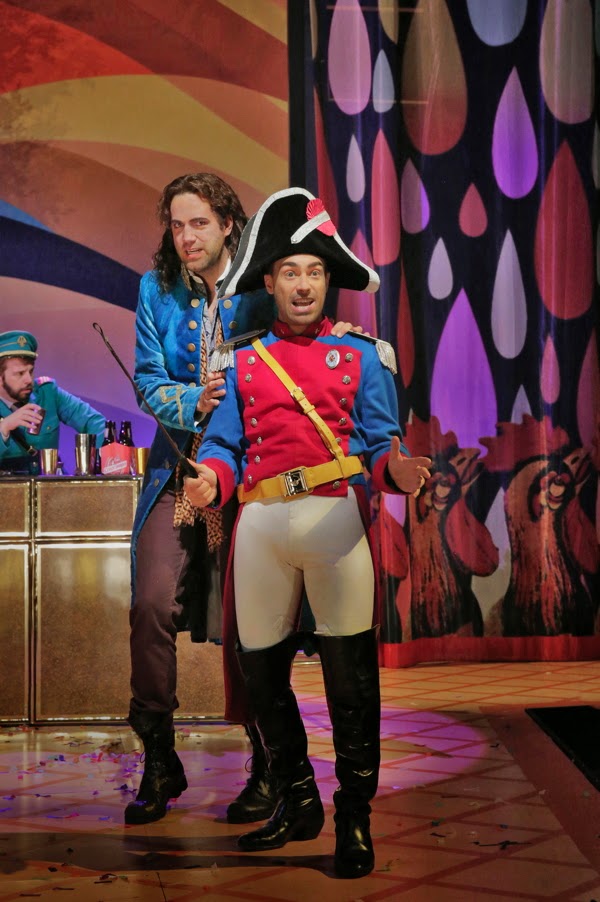
The updated bits are always funny and sometimes inspired. When, for example, Almaviva enters Bartolo's house in Act II disguised as a singing teacher so he can flirt with Rosina, he does so with a sitar and Yoga poses. Rosina's music master Don Basiliso becomes a smarmy nightclub singer, complete with a mic and an absurd Salvador Dali mustache. And the officer of the watch and guards who enter at the height of the comic chaos at the end of Act I are nothing short of living Warner Brothers cartoons, with wacky choreography courtesy of the ever-reliable Seán Curran.

And then there's the thunderstorm sequence in Act II that Rossini inserted to imply the passage of time between the scene in which Rosina, Figaro, and Almaviva plot Rosina's escape and the actual escape itself. Usually, the stage is bare. In this case, it's filled with the nightmare Bartolo has after downing one too many drinks from his bar. Dancing roosters figure prominently.

Shoko Kambara's candy-colored sets and Amanda Seymour's gaudy costumes add to the vivid cinematic imagery.

Christopher Tiesi as Almavivia, Emily Fons as
Rosina, and Jonathan Beyer as Figaro
Photo: Ken Howard
So, yes, there's plenty of action in this "Barber." And while some of it is only tangentially connected to the story, it's never allowed to draw attention from the singers and it always serves the comedy well. Even when, as in the Act I finale, there's a lot of movement going on, it's kept mostly upstage, so it's easy to keep the focus on the principals. This is a production that respects the intelligence of its audience and doesn't assume that we need to be constantly distracted in order to be entertained.

With the exception of bass-baritone Dale Travis as Bartolo, this cast is entirely new to Opera Theatre. It's always a pleasure to see some new faces on the stage, especially when they're this good.

Baritone Jonathan Beyer is Figaro, the versatile fixer who can arrange an assignation as easily as he can shave your beard. Mr. Beyer created this role in the Opera Philadelphia production, and he clearly couldn't be more comfortable in it. He's a tall, commanding comic presence on the stage with a versatile voice that's more than up to Rossini's demands. His "Largo al factotum" was gracefully done, and without the excessive ornamentation that some singers are prone to give it.

Christopher Tiesi as Almavivia
Jonathan Beyer as Figaro
Photo: Ken Howard
Christopher Tiesi is the lovelorn Almaviva, with a ringing tenor and a feel for comedy that makes him an ideal foil for Mr. Beyer's Figaro. The fact that he's so much shorter than Figaro also creates some amusing "Mutt and Jeff" images in their scenes together.

Mr. Travis is another big actor with an equally large voice, and it serves him well as the comically pompous Bartolo. He delvers Rossini's rapid patter songs with ease and impressively precise diction. South Korean bass-baritone Jeongcheol Cha rounds out the principal male cast as the wily (if ineffectual) Basilio. His "gossip" aria "La calunnia è un venticello" was a first-act highlight.

Mezzo-soprano Emily Fons is Rosina. The role was originally written for a contralto, but sopranos and mezzos have done well with it over the years, and Ms. Fons sounded entirely comfortable with it, giving us an "Una voce poco fa" in Act I that was both beautifully sung and hilariously in character. Soprano Eliza Johnson only has one short aria ("l vecchiotto cerca moglie" in Act II) as the maid Berta, but she makes it a charming little character bit.

There are fine performances as well from baritone Benjamin Taylor as Almaviva's friend Fiorello, baritone Jonathan McCullough as the increasingly rattled Officer at the end of Act I, tenor Todd Barnhill as the Notary, and tenor Geoffrey Agpalo as the servant Ambrogio.

Christoper Tiesi as Almaviva
Emily Fons as Rosina, and
Jonathan Beyer as Figaro
Photo: Ken Howard
Down in the orchestra pit, conductor Ryan McAdams does well by Rossini's infectious score, beginning with a performance of the overture that was both rousing and nuanced. There were a few moments on opening night when the orchestra and the singers sounded not entirely in synch, but on the whole it all came together splendidly.

The projected English text was a bit spotty on opening night, but given how clearly everyone in this cast enunciates I didn't find that to be an issue. The bottom line is that the things that really matter all work very well in this production, making it a lively and enjoyable opener for OTSL's 40th anniversary season.

The Opera Theatre of St. Louis production of Rossini's "Barber of Seville" continues through June 27 in rotating repertory with three other operas at the Loretto-Hilton Center on the Webster University campus. The opera is sung in English with projected English text. For ticket information: experienceopera.org.

This review originally appeared at 88.1 KDHX, where Chuck Lavazzi is the senior performing arts critic.

Tuesday, May 19, 2015

A conversation with Michael Shell, stage director for Opera Theatre's "The Barber of Seville"

Michael Shell
michaelshelldirector.com
Opera Theatre of St. Louis opens its 2015 festival season with Rossini's popular comic opera "The Barber of Seville" on Saturday, May 23rd. The production, which will run through June 27th, will alternate with three other operas on the main stage of the Loretto-Hilton Center on the Webster University campus.

This will be OTSL's sixth production of the opera. In an email interview, I asked stage director Michael Shell (who directed Mozart's "Cosi fan Tutte" for OTSL back in 2012) what to expect in this latest version of the Rossini classic.

Chuck Lavazzi (CL): When this production made its first appearance with Opera Philadelphia last October, the reviewer for PhillyNow praised its "modernist set design and colorful costumes". How would you describe the look of this new "Barber"?

Michael Shell (MS): I would describe the look of new production as vibrant, energetic and very Spanish. The music is vibrant and energetic/rhythmic. I wanted the look and feel of this production and the way we tell the story to match the vibrant rhythmic quality of the music. This is not Beaumarchais's "Barber of Seville." This is very much a Rossini comedy in the best sense. It walks the line between reality and absurdity and I wanted an environment that could sustain and allow for both. The updating of the piece, using the films of Pedro Almodovar as a jumping off point, helped give us a different way to look at the whole. Not to ignore any aspect of what was there, but allow us to go to a variety of different places.

CL: How does that vision of "Barber" influence the way you direct your singers? Is there a particular acting style you're going for that might be different from a more traditional production?

MS: I always come from a place of what does the character want and how do they get it. That is the most important thing. What changes because of this take on the show, is the how. How they go about achieving their goals becomes just as important as what the goals or objectives are. How does Bertha, for example, who I feel really loves Bartolo, go about getting him to notice her. The Count's disguise as Don Alonso allows the meaning of his words at the top of Act II "Peace and joy and understanding" to go to a different place in order to trick Bartolo.

CL: Yes. Actors can never go wrong asking "what's my objective in this scene?" regardless of whether there's music behind them or not.

MS: Absolutely!! I agree completely. Tends to not be the first thing that opera singers ask, but I am fortunate that this cast was very interested in discussing and working towards that so that we could make interesting choices on how to go about achieving their objectives.

Shell's "Cosi fan Tutte" at OTSL, 2012
experienceopera.org
CL: The notion of what's funny varies among cultures and often changes over time. Directors of Shakespeare's comedies, for example, often find themselves faced with a real challenge in keeping the shows funny for a modern audience when the references for so many of the jokes have been lost over the centuries. Do you find a similar challenge in 18th and 19th century comic operas? How do you deal with it, if so?

MS: In terms of comedies, the good comedic operas by Mozart or Rossini for example, have tapped into something that is universal and still relevant to us today. So while my choice of setting for this production is updated, and it certainly allows us to be somewhat anachronistic at times, the whole point was to tap into that universal humor that is intrinsic in the piece. And perhaps by putting it in a setting that is distant but still closer to our time than the original period, it may be more humorous to some people who might not be enticed by a traditional telling. The new touches that make it perhaps more humorous are only able to work because we have found situations that match the ones in the piece. For example - In discussion the characters with my team, we decided that because Bartolo is so blind to not only the fact that Rosina could never love him, but somewhat oblivious to everything that is going on around him, that he should be an eye doctor. And in our efforts to keep the character of Rosina from being just this bored, sometimes petulant girl, in this production, we thought that Bartolo would make her be his medical assistant / secretary in order to keep an eye on her. So in his aria near the end of Act I, we introduce a patient into the mix while Bartolo is fuming with anger at Rosina. So he is having to deal with this patient and Rosina at the same time. The exam gets out of control as he loses his cool with Rosina.

This is in no way saying that a traditional telling of this piece is equally as funny. But I figured that it might be interesting to explore a new side of this piece to do what you said about keeping it funny for a modern audience.

CL: One last question: OperaBase shows "Barber" as the eighth most performed opera in the world right now and the third most performed comedy, right behind Mozart's "Marriage of Figaro." What do you think is behind that continuing popularity?

MS: To answer your question - I think I can sum that up with one word : JOY. There is so much joy in the spirit of the piece that I think that is why it has stood the test of time. There is joy in the story, in the characters and especially Rossini's music. It is just a lot of fun to be in this world. And what I hope our production has done has created a world, that may be different than the normal one, but a world that the audience wants to be in and be a part of.

For ticket information on "The Barber of Seville," the season's other operas, and information on the entire OTSL experience (including picnic suppers on the lawn before the shows): experienceopera.org.

This article originally appeared at 88.1 KDHX, where Chuck Lavazzi is the senior performing arts critic.

Tuesday, June 24, 2014

Review of "Dialogues of the Carmelites" at Opera Theatre

Christine Brewer and cast of Dialogues of the Carmelites
Photo: Ken Howard
On July 17th, 1794, the sixteen women of the monastery of the Carmel of Compiègne in France were guillotined by the revolutionary government for refusing to abandon their vows and their community. The execution, which is widely believed to have been instrumental in bringing about the end of the Reign of Terror ten days later, inspired a novella, a play, and finally, Francis Poulenc's opera "Dialogues of the Carmelites" in 1953.

Opera Theatre's production is a good one, but I have to confess that I don't find the text of "Dialogues" all that persuasive. Adapted by the composer from the play by French Catholic writer Georges Bernanos (which was itself based the novella "The Last One at the Scaffold” by the German author Gertrud von Le Fort), the libretto far too often descends in to a mere recitation of Catholic dogma. Furthermore, as Erica Jeal noted in her review of a Royal Opera House production last month, "some of Poulenc's scenes linger beyond their usefulness to the story."

The story centers on Blanche de la Force, a young woman so consumed with fear that she screams at shadows. In an effort to escape her dread of life, she joins the convent, even though the mother superior, Madame de Croissy, is unsure of her motivation.

Kelly Kaduce
Photo: Ken Howard
Blanche soon becomes friends with cheerful (if absurdly naïve) Sister Constance and starts to settle into convent life—only to have her world turned upside down when the Reign of Terror seizes the monastery's assets and demands that the nuns abandon their community and become ordinary citizens. They refuse, deciding instead to take a vow of martyrdom. Blanche panics and runs at the last minute, but returns in the final scene to embrace death along with her compatriots.

That scene is easily the most riveting the opera. Poulenc has the nuns, now wearing the secular clothes forced on them by their jailers, singing "Salve Regina" as, one by one, they are led to the scaffold and executed. The choir becomes smaller and smaller until only Blanche is left. Her death is followed by two soft, mournful chords, a final note in the low strings, and silence.

Christine Brewer and nuns
Photo: Ken Howard
Following what appears to be a recent trend in productions of this opera, stage director Robin Guarino keeps the nuns on stage for their death scene. They all sign their character names on the upstage wall in charcoal and then walk, one by one, into the large rectangular set piece that is used for most of the interior scenes. As the blade descends (an unnervingly realistic sound effect from the percussion section), each singer drops her head to her chest and takes a seat at a bench inside the rectangle. At the end the benches are filled with downcast nuns, forever silent. Curtain.

It's a potent image and while I would have preferred the empty stage implied by the libretto to mirror the silence in the orchestra, I have to admit that it works. Indeed, the production generally makes good dramatic choices. Andrew Lieberman's stark set—there is nothing on stage aside from that big rectangular box, which shifts easily on wheels to suggest scene changes—emphasizes the stark choices available to the nuns and allows an uninterrupted dramatic flow.

The cast of this production is excellent, all the way down to the smallest parts. There are far too many of them (twenty-seven named roles) for me to list them all, so I'll concentrate on the principals.

L-R: Kelly Kaduce and Ashley Emerson
Photo: Ken Howard
Soprano Kelly Kaduce adds another feather to her already plumage-heavy cap as Blanche, credibly portraying the character's fear and doubt. Soprano Ashley Emerson is equally persuasive, making Sister Constance's simple faith charming rather than foolish (as it might seem in lesser hands). Both women sing like angels.

Contralto Meredith Arwady brings impressive vocal power and impeccable diction to the role of Madame de Croissy. Her death scene, in which her faith fails her at the end, was as harrowing as it should be. Local favorite Christine Brewer is also a vocal powerhouse as the replacement Prioress Madame Lidoine, who leads her charges to martyrdom.

Making her OTSL debut as Mother Marie, who becomes Blanche's mentor, mezzo Daveda Karanas has an arresting presence that makes it impossible not to watch her when she's on stage. She matches that with a fine, clear voice.

L-R: Meredith Arwady and Daveda Karanas
Photo: Ken Howard
Making his second appearance in the OTSL pit, former St. Louis Symphony Resident Conductor Ward Stare leads the orchestra in a forceful and impassioned reading of Poulenc's wonderfully transparent and appealing score. Some critics have compared it to film music in the way it supports and underlines the action on stage. It's not a bad analogy and, in fact, there is a cinematic quality to this production with its fluid scene changes and James F. Ingalls's dramatic lighting.

I find the theological and historical perspective of "Dialogues of the Carmelites" suspect at best and somewhat appalling at worst. The libretto glosses over the real oppression that led to the revolution—along with the Church's support for that oppression—and dotes on death in a way that frankly becomes a bit creepy. But maybe that's just because I'm a lapsed Catholic; your mileage, as they say, may vary.

The important point is that Opera Theatre is making a very strong case for "Dialogues of the Carmelites." Performances continue through June 28th at the Loretto-Hilton Center on the Webster University campus. To get the full festival experience, come early and have a picnic supper on the lawn or under the refreshment tent. You can bring your own food or purchase a gourmet supper in advance from Ces and Judy's. Drinks are available on site as well, or you can bring your own. For more information: experienceopera.org.

This review originally appeared at 88.1 KDHX, where Chuck Lavazzi is the senior performing arts critic.

Tuesday, June 17, 2014

Review of "27" at Opera Theatre

The cast of "27"
Photo by Ken Howard
Trivia question: what do Pablo Picasso, F. Scott Fitzgerald, Man Ray, Henri Matisse, and Ernest Hemingway all have in common? Answer: they all frequented the Saturday evening salons at 27 Rue de Fleurus in Paris presided over by Gertrude Stein and Alice B. Toklas. And they're all characters in the world premiere production of "27," at Opera Theatre.

The focus in "27" isn't on the famous men who displayed their genius in that salon, though. It's firmly on the two remarkable women who made it possible: expatriate American poet, novelist, and playwright Gertrude Stein and her amanuensis and lifetime companion Alice B. Toklas. The story of their love and their relationship is the backbone of the opera. It's also the basis for its most touching scene: the duet at the end of the first act in which the chiming of bells symbolizes a celebration of both Stein's genius and of the couple's love for each other. It's a lovely image, given shimmering life by Rick Ian Gordon's music, and it crops up repeatedly during the opera's ninety-minute run time.

Photo: Ken Howard
Laid out in five acts without intermission, "27" chronicles the lives and thoughts of Stein, Toklas, and many of the writers and artists who came under Stein's influence. We see Stein's break with her brother Leo (who disapproved of her relationship with Toklas), the couple's hard times during World War I, Stein's championing of the "lost generation" of writers, and Stein's survival during the Nazi occupation of France—controversial because she seems to have done so, in part, by collaborating with the Vichy government. There's a moving death scene for Stein and a final act in which Toklas, now alone, is comforted by the couple's old friend Pablo Picasso. "Picasso sketches an image of Gertrude for Alice," says the official synopsis, "as the bells of genius and love chime once more."

Royce Vavrek's libretto is poetic in a way that pays obvious homage to Stein's own work—especially her fondness for repetition—without ever descending to imitation or parody. It uses a small cast, assigning all the roles other than those of Stein and Toklas to a trio of men who appear first as characters in paintings in the salon. They play all the men who pass through the salon and all the women as well, including a comic quartet in which Toklas laments the banality of the conversations she is obliged to endure with the wives of the geniuses.

At one point they even take on the role of Stein's conscience, questioning the ethics behind her relationship with Vichy, but Mr. Vavrek otherwise plays down Stein's role as a collaborator and avoids entirely her openly Fascist politics (she was an open supporter of both Franco and Vichy leader Marshal Philippe Pétain, whom she compared favorably to George Washington). Perhaps that would have been too much to deal with in an already complex script.

Photo: Ken Howard
Mr. Gordon's score, while obviously contemporary, is clearly tonal and often harks back the musical styles of the era in which the opera is set. There are, to my ears, echoes of classic American popular song as well as the music of Virgil Thompson (for whom Stein wrote two libretti) and other mid-20th century American composers. That doesn't mean Mr. Gordon is in any way derivative, though. He clearly has his own voice. There is great beauty as well as high comedy in this music and I'd love to hear it again—which is not always the case with world premieres.

In her 1963 autobiography "What is Remembered," Alice B. Toklas recalls that Gertrude Stein's voice "was unlike anyone else's voice—deep, full, velvety, like a great contralto's, like two voices." How appropriate, then, that the role of Stein is sung by Metropolitan Opera veteran Stephanie Blythe, whose big, powerful mezzo has garnered praise in everything from "The Mikado" to the "Ring" cycle. Her Gertrude Stein commands attention the way the woman herself did in her salon. She's formidable and supremely confident—a force of nature.

Soprano Elizabeth Futral's Toklas, in contrast, reminded me of the line in "The Hound of the Baskervilles" in which Holmes tells Watson that while he is not himself luminous, he is "a conductor of light. Some people without possessing genius have a remarkable power of stimulating it." She flits and darts around the stage, always happily helping to illuminate Stein while staying in the shadows.

Mr. Gordon has given Toklas a vocal line that sounds more ornamental than Stein's, and Ms. Futral delivers it with the kind of easy grace you might expect from someone with so many coloratura roles in her pocket. She moves with a dancer's grace, and makes the character fundamentally endearing and sympathetic.

The members of the ubiquitous male trio are tenor Theo Lebow, baritone Tobias Greenhalgh, and bass-baritone Daniel Brevik. They're designated as both Gerdine Young Artists and Festival Artists—reflecting, I assume, the prominence and challenging nature of their roles. They take on a remarkable variety of roles, often with rapid costume changes, and do so brilliantly. Their individual characters are so well drawn that they create the illusion that you're seeing a much larger cast.

Photo: Ken Howard
Director James Robinson has chosen to greatly simplify the action and set elements called for in the libretto. "In order to create Gertrude's salon," he writes in his notes, "we decided that the environment should not evoke the realistic world that is so often seen in photographs." He has opted instead for "an environment of joy and nostalgia, recalling T.S. Eliot's world of 'dust in sunlight and memory in corners.'"

That means a mostly bare stage with flats decorated to look like wallpaper, a large easy chair for Stein, a smaller one for Toklas for her endless knitting, and empty picture frames representing the dozens of paintings that covered the walls at the real 27 Rue de Fleurus. Three large frames, upstage, are occupied by the members of the male trio when they're not playing real people. Everything is done in shades of gray and most of it is made to look as though it had been knitted, since a central conceit of the show is that Toklas is literally knitting her memories into existence.

That simplicity makes for fast, fluid scene changes, but it also makes some of the action unclear. In addition, the members of the male trio, when not wearing character-specific costumes, are dressed in gray singlets, so it's not always apparent whom they're supposed to represent. The only reason I know that they're supposed to be the voice of Stein's conscience at one point, for example, is because I read it in the libretto. On stage it's not at all obvious. That said, Mr. Robinson's direction seems to serve the material well in general. And some of his ideas—like Hemingway's entrance hauling the corpse of a rhino and F. Scott Fitzgerald's toy wagon loaded with liquor—are truly inspired.

The orchestra of (mostly) symphony musicians under Michael Christie performs beautifully—as they generally do.

I don't mean to suggest that I found "27" to be an unqualified success. Mr. Vavrek's libretto felt like it could use some trimming here and there, especially in the final scene. But perhaps that had more to do with the ambiguity of the direction than the text itself. Whatever the reason, "27" did seem to drag a bit at times and felt somewhat longer than its ninety minutes. The opera's positives far outweigh its negatives, though, and brand-new productions are nearly always worth seeing.

The Opera Theatre production of "27" continues through June 27th at the Loretto-Hilton Center on the Webster University campus in rotating repertory with three other operas. To get the full festival experience, come early and have a picnic supper on the lawn or under the refreshment tent. You can bring your own food or purchase a gourmet supper in advance from Ces and Judy's. Drinks are available on site as well, or you can bring your own. For more information: experienceopera.org.

This review originally appeared at 88.1 KDHX, where Chuck Lavazzi is the senior performing arts critic.

Monday, June 2, 2014

Review of "The Elixir of Love" at Opera Theatre

(L to R) René Barbera as Nemorino, Tim Mix as Belcore, and Susannah Biller as Adina
Photo by Ken Howard
I can sum up the Opera Theatre production of Donizetti's 1832 romantic comedy "The Elixir of Love" in one word: bravi. Or maybe that should be "bravissimi," since every aspect of this funny, endearing, and beautifully sung show deserves heaps of praise.

Based on Eugène Scribe's libretto for Daniel Auber's popular comedy "Le philtre" from 1831, Felice Romani's book for "The Elixir of Love" is the story of Nemorino, a humble peasant smitten with the wealthy and beautiful landowner Adina. She, though, is more taken with the macho Sergeant Belcore. In desperation, Nemorino buys a love potion (actually just some cheap wine) from the traveling quack Dr. Dulcamara. Complications, as they say, ensue. But all ends happily for everyone—including Dr. Dulcamara who, as the curtain descends, is still fleecing the suckers.

René Barbera
Directors tackling theatre pieces remote in time and place from their audiences face a tough choice. Do you retain the original setting and risk having it come across as a museum piece, or do you update it and risk distorting character relationships? It's a major question for opera directors, since the vast majority of the works in the mainstream repertoire are up to four centuries old.

Fortunately, Donizetti and his librettist Felice Romani intended "The Elixir of Love" to be somewhat remote from its original Milan audience from the start, setting it in Basque country late in the previous century. That gave James Robinson and his team, who created this production for Opera Colorado back in 2007, an inspiration: why not move it to small-town America in the early 20th century? In particular, why not set it in a time and place reminiscent of Meredith Willson's classic musical "The Music Man"—a work which, as Mr. Robinson points out in his program notes, "Elixir" somewhat resembles?

The decision makes good dramatic sense. The setting of (as it says in the program) "a small American town in 1914" is remote enough to seem as quaint to a modern audience as Basque country no doubt did to the original Milanese, yet familiar enough to still resonate. Nemorino is now a small businessman—he owns an ice cream truck—instead of a peasant, and Adina, while she wields a lot of influence, is less clearly a member of the landed gentry. Nevertheless, the difference in their status is still obvious enough to drive the story.

Susannah Biller
As Mr. Robinson noted in an article for Boulder's Daily Camera back in 2007, productions of "Elixir" are often driven by great singing (as befits the opera's status as a bel canto classic) but a real sense of character and human relationships is sometimes missing. The great strength of the OTSL cast is that they are not only great singers, they're also solid actors. Their characters are credible and their emotions believable. This is Opera Theatre doing what it does best: real theatre with splendid voices.

When I first saw tenor René Barbera (our Nemorino) three years ago in OTSL's "Daughter of the Regiment," I observed that his voice was clear, powerful, and pretty much seamless throughout the wide range called for in the role. It still is. His little aria of despair, "A furtive tear" ("Una furtive lagirma") in the second act was such a thing of beauty that shouts of "bravo" followed hard upon it.

Back then, though, I wasn't much taken with his acting ability. This time around I have no such qualms. From the moment he appeared on stage, Mr. Barbera's Nemorino was an instantly appealing mix of passion and vulnerability. He means well, but he's shy and easily bullied. He's sympathetic from the get-go—which he must be if the opera is going to work.

Patrick Carfizzi
Soprano Susannah Biller's Adina is just as perfect. Like Mr. Barbera, she has the kind of powerful, flexible voice required for coloratura roles like this one. When she and Mr. Barbera are in full flight in one of the score's many duets, it's sheer opera heaven. Her acting skills are equally fine. She establishes her character as soon as she appears on stage and remains "in the moment" throughout.

Baritone Tim Mix is the swaggering Sergeant Belcore, the role he played in the 2007 Boulder production. He, too, has a big, accurate voice that easily navigates the rapid patter Donizetti often assigns to his comic villains. His gets the character's absurdly inflated self-regard just right, which makes his eventual comeuppance as satisfying as it should be.

Bass-baritone Patrick Carfizzi has the plum role of the wily Dr. Dulcamara, peddling his patently fake patent medicine from a vintage motorcycle. The role is written for a bass, but Mr. Carfizzi sounded entirely comfortable with the low notes and rattled off the patter songs with ease and accuracy. Dulcamara is a rogue, but essentially a likeable one, and Mr. Carfizzi's performance captured the man perfectly.

Tim Mix
The role of Adina's friend Gianetta isn't a large one, but the character's voice is prominent in the opening crowd scene. Soprano Leela Subramaniam (a Gerdine Young Artist) makes a powerful first impression in that number, with a big voice the soars effortlessly over the top of the chorus. The libretto doesn't give her much to work with in creating a character, but Ms. Subramaniam has found a charmingly coquettish woman in there nevertheless.

The orchestra of (mostly) St. Louis Symphony musicians under Stephen Lord sounded gave Donizetti's music the snap and precision it needs, with some especially impressive playing from the flutes, led by Mark Sparks. This repertoire is familiar territory for Mr. Lord, and he clearly loves it.

Stage direction by Jose Maria Condemi, based on Mr. Robinson's original, is crisp and clean, creating effective stage pictures and moving the large cast on and off the unit set (with its massive bandstand) quickly and easily. That keeps the pace brisk and the action fluid. I think his decision, in the final scene, to remind us of the impending horror of The Great War is somewhat out of keeping with the sunny tone of the opera overall. But that's a minor complaint.

Designer Allen Moyer's set design, based on his Opera Colorado original, colorfully evokes the Americana of Grant Wood and Thomas Hart Benton. And that working ice cream truck is a gem.

Leela Subramaniam and Chorus
Kelley Rourke's English translation of the libretto generally works well, but includes some turns of phrase (particularly for Belcore) that seem a bit too contemporary for the 1914 setting.

Opera Theatre's production of "The Elixir of Love" runs through June 25th in rotating repertory with three other operas. To get the full festival experience, come early and have a picnic supper on the lawn or under the refreshment tent. You can bring your own food or purchase a gourmet supper in advance from Ces and Judy's. Drinks are available on site as well, or you can bring your own. For more information: experienceopera.org.

This review originally appeared at 88.1 KDHX, where Chuck Lavazzi is the senior performing arts critic.

Wednesday, May 28, 2014

Review of "The Magic Flute" at Opera Theatre of St. Louis

(L to R) Opera Theatre’s chorus, Lindsey Jones as Isis, and Dwayne Brown as Osiris
in Opera Theatre of Saint Louis’ 2014 production of The Magic Flute.
Photo © Ken Howard, 2014.
There's never a dull moment in the Opera Theatre of Saint Louis production of "The Magic Flute." That's because director Isaac Mizrahi keeps his performers (including a cast of seven dancers) in constant motion. The resulting stage pictures are impressive, but they often threaten to eclipse the music and text.

Written towards the end of the composer's sadly brief life (Mozart had only a few months to live when it premiered in September of 1791), “The Magic Flute” was intended not for an audience of nobles at court but rather for ordinary folks at a suburban theater that was closer in ambience to a tavern. A singspiel with spoken dialog instead of recitatives and a text in German instead of the fashionable Italian, the work is the fantastic tale of heroic prince Tamino and princess Pamina, daughter of the Queen of the Night, who must undergo a series of magical trials at the court of Sarastro, High Priest of the Sun, before they can attain enlightenment and be united in marriage. Accompanying Tamino in his quest is the comic bird catcher Papageno.

The work's fanciful setting and Masonic symbolism—both Mozart and his librettist Emanuel Schikaneder (the first Papageno) were members of the same lodge—have always given directors and designers ample opportunities to indulge their imaginations. Mr. Mizrahi has taken classic films as his inspiration, placing the opera on "an eternal Hollywood soundstage" and incorporating visual elements from famous movies. Thus, for example, Tamino's black and white outfit strongly echoes that of Gene Kelly in "An American in Paris," while the Three Spirits that assist Tamino, normally played by young boys, are sung here by a trio of young women decked out as toddlers and walking on their knees as in the "Triplets" number from "The Band Wagon." Papageno looks like a classic baggy pants comic, his future mate Papagena is an archetypical chorus girl, and the Queen of the Night appears to be inspired by Gloria Swanson's Norma Desmond in "Sunset Boulevard."

Photo: Ken Howard
Indeed, the Queen of the Night provides one of the opera's most visually striking moments as she sweeps up from the stage left vom in an impressive midnight blue gown with a train that follows her all the way up the stairs that lead to the upstage center catwalk, growing in volume until it fills nearly the entire stage. It's a hell of an entrance, and very effectively establishes her melodramatic and self-aggrandizing character.

Scenes in Sarastro's Temple of the Sun are equally impressive, as Mr. Mizrahi fills the stage with Shriners in red fezzes and sports coats, colorful dancing birds, and even dancing statues of Isis and Osiris.

Mr. Mizrahi has, in short, allowed his fertile imagination to give us an almost constant procession of color and movement. And that, ultimately, is the problem. Because far too often that movement pulls focus from the singers and dilutes the impact of their generally fine work. This is especially true when, early in the first act, Mr. Mizrahi begins adding dancers to the mix who shadow the singers in identical costumes and mirror in dance what they're singing. John Heginbotham's 1950s film musical–style choreography is very effective and beautifully performed, but it's also extremely distracting and has the effect, more often than not, of upstaging the singers.

That's a pity, since the cast of this "Magic Flute" is generally a good one. Tenor Sean Panikkar, last seen as Lensky in OTSL's fine "Eugene Onegin" in 2010, is pretty much an ideal Tamino, with a uniformly strong voice and solid acting skills. Baritone Levi Hernandez brings the same finely honed comic sense and crystal-clear diction to Papageno that he brought to Leporello in "Don Giovanni" two seasons ago.

Photo: Ken Howard
Soprano Elizabeth Zharoff, a former Gerdine Young Artist, is the very essence of wide-eyed innocence as Pamina, with a lovely fluid voice. Her Act II "despair" aria was masterfully done. Soprano Claire de Sévigné was a dramatic and compelling Queen of the Night, but (at least on opening night) seemed to have a couple of rough spots in the notoriously challenging Act II "revenge" aria.

Tenor Matthew DiBattista, who has graced the OTSL stage with so many fine performances in the past, delivers yet another as the villainous Monostatos, whose lustful intentions towards Pamina are repeatedly thwarted to comic effect.

Bass Matthew Anchel's Sarastro is a bit of a disappointment. A bass's very low notes are always difficult to project (and Sarastro's part goes very low in places), but even so his voice seemed to lack power throughout its range and his character came across as stilted. That might be deliberate—Mr. Mizrahi has indicated that his sympathies are more with the Queen of the Night than with Sarastro—but if that's the case I don't think it's an effective choice.

There's noteworthy work here as well in all the minor roles, all the way down to tenor Frederick Ballentine and bass-baritone Zachary Owen as the Two Armed Men, smoothly delivering their "purification" chorale prelude before Tamino and Pamina's trials by fire and water.


Photo: Ken Howard
Conductor Jane Glover, who was so impressive in Don Giovanni in 2011, once again demonstrates that she is a dab hand at Mozart, leading the musicians in a bracing and sensitive interpretation of the score. Her reading of the overture was one of the best I've heard.

Speaking of which: I have a dream that some day I'll see an opera on the Loretto Hilton stage in which the overture will not be accompanied by lots of noisy stage business. One can but hope.

In a review of Robert Lepage's Ring cycle at the Met in 2011, New York Times critic Charles Isherwood noted that “the first responsibility of the director should be serving the musical drama,” and went on to describe a production that “seems to be perpetually in competition for our attention with the opera itself.” I wouldn't go quite that far with Mr. Mizrahi's "Magic Flute" since, the dancers aside, his staging generally clarifies and enhances the opera overall, but it does often feel as though he's doing his level best to distract us with flash and glitter. I think this production, thought generally successful, could have been much better had it been much simpler.

Opera Theatre of St. Louis's "The Magic Flute" runs through June 28th in rotating repertory with three other operas. To get the full festival experience, come early and have a picnic supper on the lawn or under the refreshment tent. You can bring your own food or purchase a gourmet supper in advance from Ces and Judy's. Drinks are available on site as well, or you can bring your own. For more information: experienceopera.org.

This review originally appeared at 88.1 KDHX, where Chuck Lavazzi is the senior performing arts critic.

Friday, June 28, 2013

Review of Opera Theatre's "The Kiss"

Photo: Ken Howard
Fed up with politics? Disgusted with TV? Got a headache from 3D movies? Wilted by the heat? Well, take heart, dear friends. Opera Theatre has a charming romantic comedy for you that will take your mind off whatever’s bugging you and send you out of the theatre with a smile on your face and a Smetana melody in your heart.

The product, ironically, of a time in composer Bedřich Smetana’s life when his personal life was at a low ebb—his deafness was complete and he had lost an important job as a result—“The Kiss” is a resolutely sunny and good-natured confection of an opera with sparring lovers (a la “Much Ado About Nothing”), a hilariously crotchety father, nice-guy smugglers, and a happy ending for all. It’s filled with Smetana’s captivating melodies and lively dance-inspired rhythms and features a heroine with surprisingly modern-sounding attitudes toward the opposite sex and marriage, given that the opera premiered in 1876.

Chalk that up to the fact that the libretto is by a female author. Alžběta Pechová (writing as Eliška Krásnohorská*) wrote a total of four operas for Smetana, including “The Kiss.” “Entering into the world of these operas,” writes director Michael Gieleta in the OTSL program, “one is immediately transported into the realm of Mother Earth: into the countryside milieu of a household setting, motherhood, fertility, domestic relationships, betrothals and marriages, ill-balanced families, male faults, and female endurance.” The libretti show “the genuineness, the unquestionable emotional honesty” that comes from first-hand experience; something that “is seldom encountered in operatic portrayals penned by male librettists.” “The Kiss” looks at the quarreling lovers from a female point of view, in short, and it’s not a submissive one.

Corinne Winters
Photo: Ken Howard
Lukáš, a wealthy young farmer, had always loved Vendulka, but his parents forced him to marry another. Now a widower and orphan with a baby son, Lukáš returns to ask for Vendulka’s hand from her cynical and curmudgeonly father Palouckŷ. Papa warns that the lovers are too much alike and too stubborn to make a match, but things are going well enough until Lukáš asks for a kiss to seal the betrothal. Vendulka refuses out of consideration for the deceased wife, the argument escalates, and by the end of the first act Lukáš is off getting tanked with a couple of local lasses, Vendulka has run off with her aunt Martinka to join a band of jolly smugglers, and Palouckŷ gloats over the whole mess.

All ends happily, but not before Lukáš eats a considerable helping of humble pie and both he and Vendulka admit they might have been just a bit hasty.

The Opera Theatre production could hardly be better. Soprano Corinne Winters (who has done such fine work as Mélisande and Micaëla in the last two seasons) carries the bulk of the opera as Vendulka, convincingly portraying a wide range of emotions from joy to despair with a radiant, clear voice. Tenor Garrett Sorenson (who sang Hoffman so well back in 2008) brings that same impressive tenor to the role of Lukáš.

Bass-baritone Matthew Burns has demonstrated his flair for comedy before on the OTSL stage, so it’s no surprise that his Palouckŷ gets so many laughs. He looks a bit young for the part, though.

Emily Duncan-Brown
Photo: Ken Howard
The young servant Barče only has one aria of any consequence—the “Lark Song” from Act II—but it’s a doozy, filled with flashy vocal leaps and pyrotechnics. Soprano Emily Duncan-Brown’s performance was a true showstopper—lovely and seemingly effortless.

Baritone Matthew Worth is the mellow voice of reason as Lukáš’s brother-in-law Tomeš, mezzo Elizabeth Batton a fine comic presence as Martinka, and bass-baritone Charles Z. Owen roguishly charming as the smuggler Matouš, whose merry band brought to mind the comic pirates of Penzance.

James Macnamara’s set has an oddly artificial look for an opera filled with so many lovely musical evocations of nature. The stage floor is covered in something that looks a great deal like Astroturf and the moveable backdrop consists of long, rectangular wooden panels that wouldn’t look out of place in a high-end bar. Still, it works well enough, and Fabio Toblini’s colorful Bohemian peasant costumes add to the cheerful look of the piece.

Michael Gielata’s direction handles focus and stage movement nicely. His decision to accompany Smetana’s cheerful overture with a pantomime sequence showing the funeral of Lukáš’s wife struck me as oddly discordant, though. Conductor Anthony Barrese brings Smetana’s lively, tune-filled score to brilliant life.

“The Kiss” has one more performance on Friday, June 28, at 8 PM at the Loretto-Hilton Center on the Webster University campus. It’s a sunny, lovable piece that only someone as crabby as Palouckŷ could fail to enjoy. For more information: experienceopera.org

*Why, I have no idea.

Chuck Lavazzi is the senior performing arts critic for 88.1 KDHX, where this review originally appeared.