Tuesday, June 24, 2014

Review of "Dialogues of the Carmelites" at Opera Theatre

Christine Brewer and cast of Dialogues of the Carmelites
Photo: Ken Howard
On July 17th, 1794, the sixteen women of the monastery of the Carmel of Compiègne in France were guillotined by the revolutionary government for refusing to abandon their vows and their community. The execution, which is widely believed to have been instrumental in bringing about the end of the Reign of Terror ten days later, inspired a novella, a play, and finally, Francis Poulenc's opera "Dialogues of the Carmelites" in 1953.

Opera Theatre's production is a good one, but I have to confess that I don't find the text of "Dialogues" all that persuasive. Adapted by the composer from the play by French Catholic writer Georges Bernanos (which was itself based the novella "The Last One at the Scaffold” by the German author Gertrud von Le Fort), the libretto far too often descends in to a mere recitation of Catholic dogma. Furthermore, as Erica Jeal noted in her review of a Royal Opera House production last month, "some of Poulenc's scenes linger beyond their usefulness to the story."

The story centers on Blanche de la Force, a young woman so consumed with fear that she screams at shadows. In an effort to escape her dread of life, she joins the convent, even though the mother superior, Madame de Croissy, is unsure of her motivation.

Kelly Kaduce
Photo: Ken Howard
Blanche soon becomes friends with cheerful (if absurdly naïve) Sister Constance and starts to settle into convent life—only to have her world turned upside down when the Reign of Terror seizes the monastery's assets and demands that the nuns abandon their community and become ordinary citizens. They refuse, deciding instead to take a vow of martyrdom. Blanche panics and runs at the last minute, but returns in the final scene to embrace death along with her compatriots.

That scene is easily the most riveting the opera. Poulenc has the nuns, now wearing the secular clothes forced on them by their jailers, singing "Salve Regina" as, one by one, they are led to the scaffold and executed. The choir becomes smaller and smaller until only Blanche is left. Her death is followed by two soft, mournful chords, a final note in the low strings, and silence.

Christine Brewer and nuns
Photo: Ken Howard
Following what appears to be a recent trend in productions of this opera, stage director Robin Guarino keeps the nuns on stage for their death scene. They all sign their character names on the upstage wall in charcoal and then walk, one by one, into the large rectangular set piece that is used for most of the interior scenes. As the blade descends (an unnervingly realistic sound effect from the percussion section), each singer drops her head to her chest and takes a seat at a bench inside the rectangle. At the end the benches are filled with downcast nuns, forever silent. Curtain.

It's a potent image and while I would have preferred the empty stage implied by the libretto to mirror the silence in the orchestra, I have to admit that it works. Indeed, the production generally makes good dramatic choices. Andrew Lieberman's stark set—there is nothing on stage aside from that big rectangular box, which shifts easily on wheels to suggest scene changes—emphasizes the stark choices available to the nuns and allows an uninterrupted dramatic flow.

The cast of this production is excellent, all the way down to the smallest parts. There are far too many of them (twenty-seven named roles) for me to list them all, so I'll concentrate on the principals.

L-R: Kelly Kaduce and Ashley Emerson
Photo: Ken Howard
Soprano Kelly Kaduce adds another feather to her already plumage-heavy cap as Blanche, credibly portraying the character's fear and doubt. Soprano Ashley Emerson is equally persuasive, making Sister Constance's simple faith charming rather than foolish (as it might seem in lesser hands). Both women sing like angels.

Contralto Meredith Arwady brings impressive vocal power and impeccable diction to the role of Madame de Croissy. Her death scene, in which her faith fails her at the end, was as harrowing as it should be. Local favorite Christine Brewer is also a vocal powerhouse as the replacement Prioress Madame Lidoine, who leads her charges to martyrdom.

Making her OTSL debut as Mother Marie, who becomes Blanche's mentor, mezzo Daveda Karanas has an arresting presence that makes it impossible not to watch her when she's on stage. She matches that with a fine, clear voice.

L-R: Meredith Arwady and Daveda Karanas
Photo: Ken Howard
Making his second appearance in the OTSL pit, former St. Louis Symphony Resident Conductor Ward Stare leads the orchestra in a forceful and impassioned reading of Poulenc's wonderfully transparent and appealing score. Some critics have compared it to film music in the way it supports and underlines the action on stage. It's not a bad analogy and, in fact, there is a cinematic quality to this production with its fluid scene changes and James F. Ingalls's dramatic lighting.

I find the theological and historical perspective of "Dialogues of the Carmelites" suspect at best and somewhat appalling at worst. The libretto glosses over the real oppression that led to the revolution—along with the Church's support for that oppression—and dotes on death in a way that frankly becomes a bit creepy. But maybe that's just because I'm a lapsed Catholic; your mileage, as they say, may vary.

The important point is that Opera Theatre is making a very strong case for "Dialogues of the Carmelites." Performances continue through June 28th at the Loretto-Hilton Center on the Webster University campus. To get the full festival experience, come early and have a picnic supper on the lawn or under the refreshment tent. You can bring your own food or purchase a gourmet supper in advance from Ces and Judy's. Drinks are available on site as well, or you can bring your own. For more information: experienceopera.org.

This review originally appeared at 88.1 KDHX, where Chuck Lavazzi is the senior performing arts critic.

Tuesday, June 17, 2014

Review of "27" at Opera Theatre

The cast of "27"
Photo by Ken Howard
Trivia question: what do Pablo Picasso, F. Scott Fitzgerald, Man Ray, Henri Matisse, and Ernest Hemingway all have in common? Answer: they all frequented the Saturday evening salons at 27 Rue de Fleurus in Paris presided over by Gertrude Stein and Alice B. Toklas. And they're all characters in the world premiere production of "27," at Opera Theatre.

The focus in "27" isn't on the famous men who displayed their genius in that salon, though. It's firmly on the two remarkable women who made it possible: expatriate American poet, novelist, and playwright Gertrude Stein and her amanuensis and lifetime companion Alice B. Toklas. The story of their love and their relationship is the backbone of the opera. It's also the basis for its most touching scene: the duet at the end of the first act in which the chiming of bells symbolizes a celebration of both Stein's genius and of the couple's love for each other. It's a lovely image, given shimmering life by Rick Ian Gordon's music, and it crops up repeatedly during the opera's ninety-minute run time.

Photo: Ken Howard
Laid out in five acts without intermission, "27" chronicles the lives and thoughts of Stein, Toklas, and many of the writers and artists who came under Stein's influence. We see Stein's break with her brother Leo (who disapproved of her relationship with Toklas), the couple's hard times during World War I, Stein's championing of the "lost generation" of writers, and Stein's survival during the Nazi occupation of France—controversial because she seems to have done so, in part, by collaborating with the Vichy government. There's a moving death scene for Stein and a final act in which Toklas, now alone, is comforted by the couple's old friend Pablo Picasso. "Picasso sketches an image of Gertrude for Alice," says the official synopsis, "as the bells of genius and love chime once more."

Royce Vavrek's libretto is poetic in a way that pays obvious homage to Stein's own work—especially her fondness for repetition—without ever descending to imitation or parody. It uses a small cast, assigning all the roles other than those of Stein and Toklas to a trio of men who appear first as characters in paintings in the salon. They play all the men who pass through the salon and all the women as well, including a comic quartet in which Toklas laments the banality of the conversations she is obliged to endure with the wives of the geniuses.

At one point they even take on the role of Stein's conscience, questioning the ethics behind her relationship with Vichy, but Mr. Vavrek otherwise plays down Stein's role as a collaborator and avoids entirely her openly Fascist politics (she was an open supporter of both Franco and Vichy leader Marshal Philippe Pétain, whom she compared favorably to George Washington). Perhaps that would have been too much to deal with in an already complex script.

Photo: Ken Howard
Mr. Gordon's score, while obviously contemporary, is clearly tonal and often harks back the musical styles of the era in which the opera is set. There are, to my ears, echoes of classic American popular song as well as the music of Virgil Thompson (for whom Stein wrote two libretti) and other mid-20th century American composers. That doesn't mean Mr. Gordon is in any way derivative, though. He clearly has his own voice. There is great beauty as well as high comedy in this music and I'd love to hear it again—which is not always the case with world premieres.

In her 1963 autobiography "What is Remembered," Alice B. Toklas recalls that Gertrude Stein's voice "was unlike anyone else's voice—deep, full, velvety, like a great contralto's, like two voices." How appropriate, then, that the role of Stein is sung by Metropolitan Opera veteran Stephanie Blythe, whose big, powerful mezzo has garnered praise in everything from "The Mikado" to the "Ring" cycle. Her Gertrude Stein commands attention the way the woman herself did in her salon. She's formidable and supremely confident—a force of nature.

Soprano Elizabeth Futral's Toklas, in contrast, reminded me of the line in "The Hound of the Baskervilles" in which Holmes tells Watson that while he is not himself luminous, he is "a conductor of light. Some people without possessing genius have a remarkable power of stimulating it." She flits and darts around the stage, always happily helping to illuminate Stein while staying in the shadows.

Mr. Gordon has given Toklas a vocal line that sounds more ornamental than Stein's, and Ms. Futral delivers it with the kind of easy grace you might expect from someone with so many coloratura roles in her pocket. She moves with a dancer's grace, and makes the character fundamentally endearing and sympathetic.

The members of the ubiquitous male trio are tenor Theo Lebow, baritone Tobias Greenhalgh, and bass-baritone Daniel Brevik. They're designated as both Gerdine Young Artists and Festival Artists—reflecting, I assume, the prominence and challenging nature of their roles. They take on a remarkable variety of roles, often with rapid costume changes, and do so brilliantly. Their individual characters are so well drawn that they create the illusion that you're seeing a much larger cast.

Photo: Ken Howard
Director James Robinson has chosen to greatly simplify the action and set elements called for in the libretto. "In order to create Gertrude's salon," he writes in his notes, "we decided that the environment should not evoke the realistic world that is so often seen in photographs." He has opted instead for "an environment of joy and nostalgia, recalling T.S. Eliot's world of 'dust in sunlight and memory in corners.'"

That means a mostly bare stage with flats decorated to look like wallpaper, a large easy chair for Stein, a smaller one for Toklas for her endless knitting, and empty picture frames representing the dozens of paintings that covered the walls at the real 27 Rue de Fleurus. Three large frames, upstage, are occupied by the members of the male trio when they're not playing real people. Everything is done in shades of gray and most of it is made to look as though it had been knitted, since a central conceit of the show is that Toklas is literally knitting her memories into existence.

That simplicity makes for fast, fluid scene changes, but it also makes some of the action unclear. In addition, the members of the male trio, when not wearing character-specific costumes, are dressed in gray singlets, so it's not always apparent whom they're supposed to represent. The only reason I know that they're supposed to be the voice of Stein's conscience at one point, for example, is because I read it in the libretto. On stage it's not at all obvious. That said, Mr. Robinson's direction seems to serve the material well in general. And some of his ideas—like Hemingway's entrance hauling the corpse of a rhino and F. Scott Fitzgerald's toy wagon loaded with liquor—are truly inspired.

The orchestra of (mostly) symphony musicians under Michael Christie performs beautifully—as they generally do.

I don't mean to suggest that I found "27" to be an unqualified success. Mr. Vavrek's libretto felt like it could use some trimming here and there, especially in the final scene. But perhaps that had more to do with the ambiguity of the direction than the text itself. Whatever the reason, "27" did seem to drag a bit at times and felt somewhat longer than its ninety minutes. The opera's positives far outweigh its negatives, though, and brand-new productions are nearly always worth seeing.

The Opera Theatre production of "27" continues through June 27th at the Loretto-Hilton Center on the Webster University campus in rotating repertory with three other operas. To get the full festival experience, come early and have a picnic supper on the lawn or under the refreshment tent. You can bring your own food or purchase a gourmet supper in advance from Ces and Judy's. Drinks are available on site as well, or you can bring your own. For more information: experienceopera.org.

This review originally appeared at 88.1 KDHX, where Chuck Lavazzi is the senior performing arts critic.

Monday, June 2, 2014

Review of "The Elixir of Love" at Opera Theatre

(L to R) René Barbera as Nemorino, Tim Mix as Belcore, and Susannah Biller as Adina
Photo by Ken Howard
I can sum up the Opera Theatre production of Donizetti's 1832 romantic comedy "The Elixir of Love" in one word: bravi. Or maybe that should be "bravissimi," since every aspect of this funny, endearing, and beautifully sung show deserves heaps of praise.

Based on Eugène Scribe's libretto for Daniel Auber's popular comedy "Le philtre" from 1831, Felice Romani's book for "The Elixir of Love" is the story of Nemorino, a humble peasant smitten with the wealthy and beautiful landowner Adina. She, though, is more taken with the macho Sergeant Belcore. In desperation, Nemorino buys a love potion (actually just some cheap wine) from the traveling quack Dr. Dulcamara. Complications, as they say, ensue. But all ends happily for everyone—including Dr. Dulcamara who, as the curtain descends, is still fleecing the suckers.

René Barbera
Directors tackling theatre pieces remote in time and place from their audiences face a tough choice. Do you retain the original setting and risk having it come across as a museum piece, or do you update it and risk distorting character relationships? It's a major question for opera directors, since the vast majority of the works in the mainstream repertoire are up to four centuries old.

Fortunately, Donizetti and his librettist Felice Romani intended "The Elixir of Love" to be somewhat remote from its original Milan audience from the start, setting it in Basque country late in the previous century. That gave James Robinson and his team, who created this production for Opera Colorado back in 2007, an inspiration: why not move it to small-town America in the early 20th century? In particular, why not set it in a time and place reminiscent of Meredith Willson's classic musical "The Music Man"—a work which, as Mr. Robinson points out in his program notes, "Elixir" somewhat resembles?

The decision makes good dramatic sense. The setting of (as it says in the program) "a small American town in 1914" is remote enough to seem as quaint to a modern audience as Basque country no doubt did to the original Milanese, yet familiar enough to still resonate. Nemorino is now a small businessman—he owns an ice cream truck—instead of a peasant, and Adina, while she wields a lot of influence, is less clearly a member of the landed gentry. Nevertheless, the difference in their status is still obvious enough to drive the story.

Susannah Biller
As Mr. Robinson noted in an article for Boulder's Daily Camera back in 2007, productions of "Elixir" are often driven by great singing (as befits the opera's status as a bel canto classic) but a real sense of character and human relationships is sometimes missing. The great strength of the OTSL cast is that they are not only great singers, they're also solid actors. Their characters are credible and their emotions believable. This is Opera Theatre doing what it does best: real theatre with splendid voices.

When I first saw tenor René Barbera (our Nemorino) three years ago in OTSL's "Daughter of the Regiment," I observed that his voice was clear, powerful, and pretty much seamless throughout the wide range called for in the role. It still is. His little aria of despair, "A furtive tear" ("Una furtive lagirma") in the second act was such a thing of beauty that shouts of "bravo" followed hard upon it.

Back then, though, I wasn't much taken with his acting ability. This time around I have no such qualms. From the moment he appeared on stage, Mr. Barbera's Nemorino was an instantly appealing mix of passion and vulnerability. He means well, but he's shy and easily bullied. He's sympathetic from the get-go—which he must be if the opera is going to work.

Patrick Carfizzi
Soprano Susannah Biller's Adina is just as perfect. Like Mr. Barbera, she has the kind of powerful, flexible voice required for coloratura roles like this one. When she and Mr. Barbera are in full flight in one of the score's many duets, it's sheer opera heaven. Her acting skills are equally fine. She establishes her character as soon as she appears on stage and remains "in the moment" throughout.

Baritone Tim Mix is the swaggering Sergeant Belcore, the role he played in the 2007 Boulder production. He, too, has a big, accurate voice that easily navigates the rapid patter Donizetti often assigns to his comic villains. His gets the character's absurdly inflated self-regard just right, which makes his eventual comeuppance as satisfying as it should be.

Bass-baritone Patrick Carfizzi has the plum role of the wily Dr. Dulcamara, peddling his patently fake patent medicine from a vintage motorcycle. The role is written for a bass, but Mr. Carfizzi sounded entirely comfortable with the low notes and rattled off the patter songs with ease and accuracy. Dulcamara is a rogue, but essentially a likeable one, and Mr. Carfizzi's performance captured the man perfectly.

Tim Mix
The role of Adina's friend Gianetta isn't a large one, but the character's voice is prominent in the opening crowd scene. Soprano Leela Subramaniam (a Gerdine Young Artist) makes a powerful first impression in that number, with a big voice the soars effortlessly over the top of the chorus. The libretto doesn't give her much to work with in creating a character, but Ms. Subramaniam has found a charmingly coquettish woman in there nevertheless.

The orchestra of (mostly) St. Louis Symphony musicians under Stephen Lord sounded gave Donizetti's music the snap and precision it needs, with some especially impressive playing from the flutes, led by Mark Sparks. This repertoire is familiar territory for Mr. Lord, and he clearly loves it.

Stage direction by Jose Maria Condemi, based on Mr. Robinson's original, is crisp and clean, creating effective stage pictures and moving the large cast on and off the unit set (with its massive bandstand) quickly and easily. That keeps the pace brisk and the action fluid. I think his decision, in the final scene, to remind us of the impending horror of The Great War is somewhat out of keeping with the sunny tone of the opera overall. But that's a minor complaint.

Designer Allen Moyer's set design, based on his Opera Colorado original, colorfully evokes the Americana of Grant Wood and Thomas Hart Benton. And that working ice cream truck is a gem.

Leela Subramaniam and Chorus
Kelley Rourke's English translation of the libretto generally works well, but includes some turns of phrase (particularly for Belcore) that seem a bit too contemporary for the 1914 setting.

Opera Theatre's production of "The Elixir of Love" runs through June 25th in rotating repertory with three other operas. To get the full festival experience, come early and have a picnic supper on the lawn or under the refreshment tent. You can bring your own food or purchase a gourmet supper in advance from Ces and Judy's. Drinks are available on site as well, or you can bring your own. For more information: experienceopera.org.

This review originally appeared at 88.1 KDHX, where Chuck Lavazzi is the senior performing arts critic.

Wednesday, May 28, 2014

Review of "The Magic Flute" at Opera Theatre of St. Louis

(L to R) Opera Theatre’s chorus, Lindsey Jones as Isis, and Dwayne Brown as Osiris
in Opera Theatre of Saint Louis’ 2014 production of The Magic Flute.
Photo © Ken Howard, 2014.
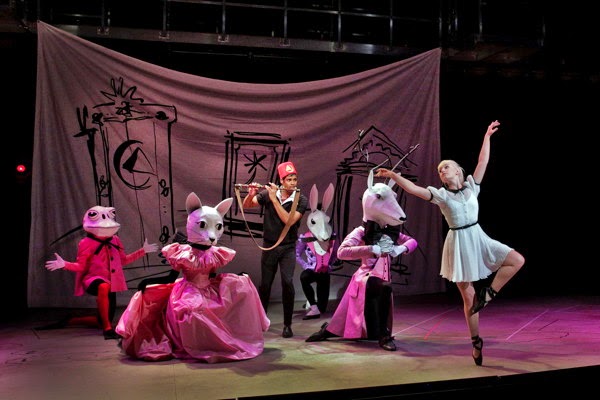
There's never a dull moment in the Opera Theatre of Saint Louis production of "The Magic Flute." That's because director Isaac Mizrahi keeps his performers (including a cast of seven dancers) in constant motion. The resulting stage pictures are impressive, but they often threaten to eclipse the music and text.

Written towards the end of the composer's sadly brief life (Mozart had only a few months to live when it premiered in September of 1791), “The Magic Flute” was intended not for an audience of nobles at court but rather for ordinary folks at a suburban theater that was closer in ambience to a tavern. A singspiel with spoken dialog instead of recitatives and a text in German instead of the fashionable Italian, the work is the fantastic tale of heroic prince Tamino and princess Pamina, daughter of the Queen of the Night, who must undergo a series of magical trials at the court of Sarastro, High Priest of the Sun, before they can attain enlightenment and be united in marriage. Accompanying Tamino in his quest is the comic bird catcher Papageno.

The work's fanciful setting and Masonic symbolism—both Mozart and his librettist Emanuel Schikaneder (the first Papageno) were members of the same lodge—have always given directors and designers ample opportunities to indulge their imaginations. Mr. Mizrahi has taken classic films as his inspiration, placing the opera on "an eternal Hollywood soundstage" and incorporating visual elements from famous movies. Thus, for example, Tamino's black and white outfit strongly echoes that of Gene Kelly in "An American in Paris," while the Three Spirits that assist Tamino, normally played by young boys, are sung here by a trio of young women decked out as toddlers and walking on their knees as in the "Triplets" number from "The Band Wagon." Papageno looks like a classic baggy pants comic, his future mate Papagena is an archetypical chorus girl, and the Queen of the Night appears to be inspired by Gloria Swanson's Norma Desmond in "Sunset Boulevard."

Photo: Ken Howard
Indeed, the Queen of the Night provides one of the opera's most visually striking moments as she sweeps up from the stage left vom in an impressive midnight blue gown with a train that follows her all the way up the stairs that lead to the upstage center catwalk, growing in volume until it fills nearly the entire stage. It's a hell of an entrance, and very effectively establishes her melodramatic and self-aggrandizing character.

Scenes in Sarastro's Temple of the Sun are equally impressive, as Mr. Mizrahi fills the stage with Shriners in red fezzes and sports coats, colorful dancing birds, and even dancing statues of Isis and Osiris.

Mr. Mizrahi has, in short, allowed his fertile imagination to give us an almost constant procession of color and movement. And that, ultimately, is the problem. Because far too often that movement pulls focus from the singers and dilutes the impact of their generally fine work. This is especially true when, early in the first act, Mr. Mizrahi begins adding dancers to the mix who shadow the singers in identical costumes and mirror in dance what they're singing. John Heginbotham's 1950s film musical–style choreography is very effective and beautifully performed, but it's also extremely distracting and has the effect, more often than not, of upstaging the singers.

That's a pity, since the cast of this "Magic Flute" is generally a good one. Tenor Sean Panikkar, last seen as Lensky in OTSL's fine "Eugene Onegin" in 2010, is pretty much an ideal Tamino, with a uniformly strong voice and solid acting skills. Baritone Levi Hernandez brings the same finely honed comic sense and crystal-clear diction to Papageno that he brought to Leporello in "Don Giovanni" two seasons ago.

Photo: Ken Howard
Soprano Elizabeth Zharoff, a former Gerdine Young Artist, is the very essence of wide-eyed innocence as Pamina, with a lovely fluid voice. Her Act II "despair" aria was masterfully done. Soprano Claire de Sévigné was a dramatic and compelling Queen of the Night, but (at least on opening night) seemed to have a couple of rough spots in the notoriously challenging Act II "revenge" aria.

Tenor Matthew DiBattista, who has graced the OTSL stage with so many fine performances in the past, delivers yet another as the villainous Monostatos, whose lustful intentions towards Pamina are repeatedly thwarted to comic effect.

Bass Matthew Anchel's Sarastro is a bit of a disappointment. A bass's very low notes are always difficult to project (and Sarastro's part goes very low in places), but even so his voice seemed to lack power throughout its range and his character came across as stilted. That might be deliberate—Mr. Mizrahi has indicated that his sympathies are more with the Queen of the Night than with Sarastro—but if that's the case I don't think it's an effective choice.

There's noteworthy work here as well in all the minor roles, all the way down to tenor Frederick Ballentine and bass-baritone Zachary Owen as the Two Armed Men, smoothly delivering their "purification" chorale prelude before Tamino and Pamina's trials by fire and water.


Photo: Ken Howard
Conductor Jane Glover, who was so impressive in Don Giovanni in 2011, once again demonstrates that she is a dab hand at Mozart, leading the musicians in a bracing and sensitive interpretation of the score. Her reading of the overture was one of the best I've heard.

Speaking of which: I have a dream that some day I'll see an opera on the Loretto Hilton stage in which the overture will not be accompanied by lots of noisy stage business. One can but hope.

In a review of Robert Lepage's Ring cycle at the Met in 2011, New York Times critic Charles Isherwood noted that “the first responsibility of the director should be serving the musical drama,” and went on to describe a production that “seems to be perpetually in competition for our attention with the opera itself.” I wouldn't go quite that far with Mr. Mizrahi's "Magic Flute" since, the dancers aside, his staging generally clarifies and enhances the opera overall, but it does often feel as though he's doing his level best to distract us with flash and glitter. I think this production, thought generally successful, could have been much better had it been much simpler.

Opera Theatre of St. Louis's "The Magic Flute" runs through June 28th in rotating repertory with three other operas. To get the full festival experience, come early and have a picnic supper on the lawn or under the refreshment tent. You can bring your own food or purchase a gourmet supper in advance from Ces and Judy's. Drinks are available on site as well, or you can bring your own. For more information: experienceopera.org.

This review originally appeared at 88.1 KDHX, where Chuck Lavazzi is the senior performing arts critic.

Thursday, November 14, 2013

Great Britten: The symphony presents Benjamin Britten's "Peter Grimes" in concert Saturday, November 16, 2013

Anthony Dean Griffey as Peter Grimes in Toronto
Writing in the Larousse Encyclopedia of Music, Donald Paine notes that Benjamin Britten's "War Requiem," written for the consecration of Coventry Cathedral in 1962, "may stand as representative of his genius and of the theme that recurs throughout his work: the indictment of human folly as it shows itself both in the tragedy and wastage of war and in the corruption of human innocence."

Those themes are present both in the "War Requiem" and in Britten's 1945 tragic opera "Peter Grimes."  Coincidentally, both works are being performed this weekend in the Midwest: the "War Requiem" in a series of concerts in Chicago Thursday through Sunday and "Peter Grimes" in a special concert performance on Saturday night here in St. Louis by the St. Louis Symphony Orchestra and Chorus.

The Chicago performances are part of the Chicago Symphony's regular subscription series.  The Saturday special here is a preview of the "Peter Grimes" the symphony will be presenting in Carnegie Hall in New York on Friday, November 22nd—the 100th anniversary of Britten's birth.  It's one of over 1000 special concert events being presented this year to celebrate the great English composer's centenary; you can see a complete list at the Britten 100 web site.

Benjamin Britten
London Records 1968
publicity photo
Born in East Anglia in 1913, Britten studied composition with Frank Bridge and John Ireland.  He lived in the USA from 1939 to 1942 and then returned to settle in Aldeburgh, Suffolk, where he would remain the rest of his life.  Although he got international attention with his "Variations on a Theme of Frank Bridge" for strings in 1937, it wasn't until the 1940s that his music began to achieve widespread acceptance, with performances of his "Ceremony of Carols" (a worldwide favorite around this time of year), the "Sinfonia da Requiem," and, of course, "Peter Grimes"—a huge hit with audiences and critics alike in 1945.  By the time Britten died in 1976 he was firmly established as one of the most important figures in 20th century music.

Most classical fans are familiar with the "Four Sea Interludes from Peter Grimes."  These little gems are powerfully evocative of the geographical and psychological landscape of the opera.  They're also a nice distillation of what you can expect from the complete performance of the opera on Saturday.

Inspired by a section of the poem "The Borough" by clergyman and poet George Crabbe (1754-1832), the story revolves around the persecution of the title character – a sullen and socially awkward fisherman – by the denizens of a small coastal fishing village.  In the poem he's a clear villain but in Montagu Slater's libretto it's ambiguous how much of Grimes's tragic end is his fault and how much the result of persecution by villagers.  What's not ambiguous is that, even at the relatively young age of 31, Britten was already a master of orchestral color and mood.

"Britten," writes Paul Schiavo in his program notes, "declared that the struggle between the exceptional individual and society was ‘a subject very close to my heart.' That Peter Grimes portrays that struggle through a decidedly flawed character, less hero than anti-hero, makes it a challenging work but not a less compelling one."  It's also possible that Britten intended the work to serve, to some extent, as a condemnation of the homophobia which Britten, as a gay man, saw quite clearly in British society.

The soloists for Saturday's performance include tenor Anthony Dean Griffey as Peter Grimes (a role he has sung often, including at the Metropolitan Opera in New York), soprano Susanna Phillips as schoolmistress Ellen Orford (who suspects—but can't prove—that Grimes might be abusing his young apprentice, John), bass-baritone Alan Held as Captain Balstrode (in whom Ellen confides), and contralto Meredith Arwady as Auntie (who helps stir the mob up against Grimes).  David Robertson conducts the orchestra and chorus.

The chorus plays an important narrative role in "Peter Grimes," so precision in singing and diction will be important.  Fortunately chorus director Amy Kaiser has an awfully good track record in that regard.

"Peter Grimes" is a big undertaking for the symphony, which does a relatively small number of chorus and orchestra pieces every season and rarely anything on quite this scale.  Those chorus and orchestra concerts have, however, generally been season highlights, so I think you'll find it interesting to see and hear the results—and to see what the New York critics have to say on the 22nd.

"Peter Grimes" will be performed on Saturday, November 16, at 8 PM at Powell Hall and will be broadcast on St. Louis Public Radio at 90.7 FM, HD 1, and via streaming at the station's web site.  For more information: stlsymphony.org.

This article originally appeared at OnSTL.com, where Chuck Lavazzi is a performing arts blogger.

Tuesday, November 12, 2013

Review of Winter Opera's "Faust"

Julia Ebner as Marguerite,Timothy J. Bruno as Mephistopheles
and Clay Hilley as Faust
© Ron Lindsey, 2013
Long regarded by many as one of the highlights of the French grand opera tradition, Gounod's "Faust"—a beautifully sung production of which opened Winter Opera’s season—actually started life in 1859 as an opéra comique with spoken dialog instead of recitatives and without large ballet sequences. It was only the addition of the former in 1860 and the latter in 1875 that elevated Faust to the position of eminence it held in opera houses for over a century.

But in dealing with weighty subjects the reach of Gounod and his librettists Jules Barbier and Michel Carré mostly exceed their grasp. The music still retains most of its power but the libretto has aged badly and now looks quaint and even dramatically inert at times.

"Satan", the a 1927 lyric by Leo Robin and Clifford Grey tells us, "lies awaitin' and creatin' clouds of gray."* In "Faust" Mephistopheles fills the lives of Faust, Marguerite, and Marguerite's family with clouds that aren't gray so much as the sort of greenish black we Midwesterners have come to associate with tornado season. By the end of Act 5 (Act 3 in this production), there has been enough death, scandal, and misery loosed upon the stage to fill up at least fifteen minutes of a cable news broadcast.

Julia Ebner as Marguerite,
Timothy J. Bruno as Mephistopheles
and Clay Hilley as Faust
© Ron Lindsey, 2013
This could be tremendously powerful stuff, but the libretto—based on Carré's play "Faust et Marguerite," which is very freely adapted from Part 1 of Goethe’s "Faust"—deals with it in such a pedestrian way that Faust, for example, comes off as little more than a shallow fool. Tenor Clay Hilley brought a truly wonderful voice to the role, fortunately, garnering his share of "bravos". His acting was not at quite at the level of his voice—his aged Faust was too exaggerated to be credible and his youthful Faust struck me as a bit bland—but there was no gainsaying the quality of his singing.

Soprano Julia Ebner was a very effective Marguerite, with a fine, supple voice and respectable acting chops. Bass Timothy J. Bruno’s Méphistophélès was also a vocal triumph, but I felt he failed to convey the character’s menace. His mocking Act 3 serenade, "Vous qui faites l'endormie," ideally a compelling display of sheer malevolence, felt under-played to me.

One of the strongest overall performances came from baritone Eric McKeever as Marguerite’s brother Valentin. "O sainte médaille," the Act 1 aria in which he entrusts the care of Marguerite to young Siébel (a "pants" role, nicely done by mezzo Cherry Duke) was a true showstopper and got the first "bravo" of the day.

John Stephens’s direction, while serviceable, was sometimes rather static. Ensemble scenes, in particular, tended to consist of having chorus members line up, face front, and sing with very little movement. Part of the problem, of course, was that Scott Loebl’s unit set consisted of a wall with a scrim stage left, a door unit center, and a set of stairs leading down to floor level stage right. The stone wall look was great, but its size tended to push all the action downstage. I would think those stairs could have been used in some of the chorus scenes to relieve the congestion.

The Act I waltz scene © Ron Lindsey, 2013
He did, on the other hand, come up with a neat solution to the problem posed by the lack of room for dancing in the famous Act 1 (original Act 2) waltz sequence.  He brought on a pair of ballroom dancers (Stephanie Medeiros and Atanas Pavlov) to do a flashy waltz number of their own.  They apparently beamed in from the 20th century, but it was certainly a theatrically effective moment.

JC Krajicek’s costumes (some of them ill fitting) seemed to have been assembled from several different shows, resulting in an opera that was apparently taking place in no fixed time or place. If that was designed to make the story more universal, I’m not sure it really worked. And that gray brocade suite for Faust made him look more silly than seductive.

Michael Mishra led the orchestra brilliantly, and their playing generally sounded quite polished. The instrumental/vocal balance was very good as well. I didn’t see a chorus master listed, but whoever rehearsed the ensemble did a fine job; the chorus sang with a precision and clarity that was wonderful to hear.

Winter Opera has come a long way in just seven seasons. Now that they’re getting some corporate sponsorship and have apparently settled in at the Viragh Center—one of the best musical theatre houses in town, hands down—I expect them to continue to be a critical part of the local opera scene. If they can get the theatrical aspects of their productions up to the same high level as the musical ones, they will truly be a force to be reckoned with.

Winter Opera’s next show is Verdi’s "Falstaff," one of the Italian master’s very best works, with a first-rate libretto by Boito. Performances are Friday and Sunday, February 7 and 9, 2014. There will also be another special "Holidays on the Hill" show December 10, 12, and 17 at Dominic’s Restaurant. Fore more information: winteroperastl.org.

*"Hallelujah," from "Hit the Deck." Music is by Vincent Youmans

This review originally appeared at 88.1 KDHX, where Chuck Lavazzi is the senior performing arts critic.

Friday, September 13, 2013

Winter Opera Saint Louis Interviewed on STL TV

Winter Opera Saint Louis General Director Gina Galati and Music Director Steven Jarvi sat down for an interview with STL TV to discuss the company and its upcoming seventh season.


(The above embedded video is a playlist of two videos.)

Winter Opera Saint Louis's season begins on November 8 & 10 with Faust, then continues with Falstaff in February and Lucia di Lammermoor in March. Performances take place at the Skip Viragh Center for the Arts at Chaminade (425 S. Lindbergh Blvd, St. Louis, MO, 63131). Tickets and more information can be found by calling 314-865-0038 or visiting winteroperastl.org