Wednesday, July 31, 2013

Rehearsal of UAO's "Die Walküre"

Rehearsals are underway for Union Avenue Opera's Die Walküre, the second part of Richard Wagner's Ring Cycle. UAO's artists arrived in St. Louis on Monday to begin the three-week rehearsal process. Take a look at Conductor Scott Schoonover leading Soprano Alexandra LoBianco and Bass Timothy Bruno in musical rehearsal.

Alexandra LoBianco
Photo © Phil Touchette, 2013
All Rights Reserved
LoBianco returns to UAO, singing the celebrated role of Brünnhilde. Her previous critically-acclaimed performances at UAO include Leonora in Il Trovatore (2009) and the title role in 2011's Turandot.

Timothy Bruno
Photo © Phil Touchette, 2013
All Rights Reserved
Bruno, who has sung for Cincinnati Opera, Toledo Opera and Opera Saratoga, makes his UAO debut as Wotan, ruler of the Gods.

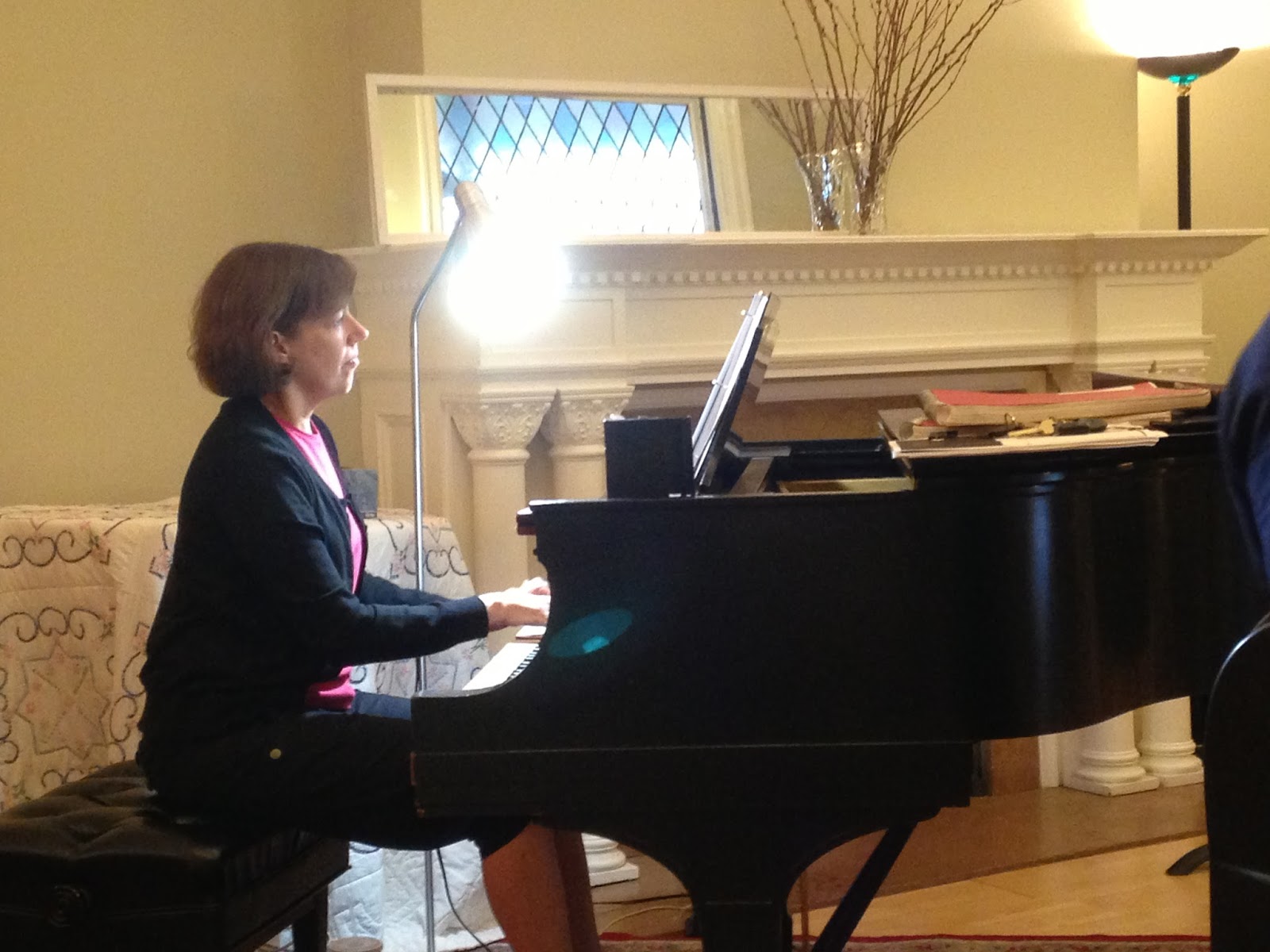
Nancy Mayo
Photo © Phil Touchette, 2013
All Rights Reserved
Rehearsal Pianist Nancy Mayo returns after several seasons with UAO. 

Alexandra LoBianco & Timothy Bruno
Photo © Phil Touchette, 2013
All Rights Reserved

LoBianco and Bruno rehearse the duet between Brünnhilde and Wotan at the conclusion of the opera. 

Die Walküre runs August 16, 17, 23 and 24 at 8pm. Venue: Union Avenue Opera, 733 N. Union Blvd. Production sung in German with projected English supertitles. Get your Tickets online at www.unionavenueopera.org or by calling 314-361-2881.

Tuesday, July 16, 2013

Review of Union Avenue Opera's "Madama Butterfly"

(c) 2013 Ron Lindsey
It has been ten years since Union Avenue Opera presented Puccini’s 1904 “Japanese Tragedy” “Madama Butterfly”, and if the current production is any indication, they have waited far too long. Musically and dramatically it’s solid work, with eye-catching sets and costumes to boot.

Honesty compels me to admit I have never been a great admirer of “Madama Butterfly”. On the one hand, I have always regarded Pinkerton, the sailor who seduces and abandons the title character, as the prototypical Ugly American. Arrogant, self-centered, and chauvinistic, he's a sort of seagoing Rush Limbaugh. On the other, the Geisha Cio-Cio-San (a.k.a. Madama Butterfly) displays, as written, a degree of naiveté which, despite her youth (she’s supposed to be fifteen when she marries Pinkerton), borders on the delusional. As a result, the tragedy has always struck me as a bit forced.

Still, even I get a bit choked up in the opera’s final pages. From the scene in which the abandoned Butterfly prepares to take her own life after a tearful farewell to the son she has conceived by Pinkerton (and which poverty now obliges her to give up to Pinkerton and his American wife) to the final moment when Pinkerton, unable to deny what he has done, collapses in a heap of grief and guilt over Cio-Cio-San’s body, it’s pathos all the way, folks. This is Puccini, after all, and for me, at least, the emotional pull of his music is what raises “Butterfly” above the level of sordid melodrama.

And, of course, the moral issues it raises about power and principle are as valid now as they were over a century ago, both on the personal and national levels.
First-rate singing and acting by Union Avenue’s cast go a long way towards mitigating what I see as the opera’s weaknesses. Soprano Ann Wazelle’s Butterfly has just a bit more maturity and backbone than one usually sees in the role, which gives her character a bit more depth and Butterfly’s suicide an interesting element of defiance. She seemed to have a bit of difficulty belting out some top notes on opening night (although her high pianissimos were lovely), but was otherwise in excellent voice. I was not surprised to learn that she has substantial theatrical credentials as well as musical ones.

The role of Pinkerton is a familiar one for tenor Mathew Edwardsen, and he plays it with assurance and conviction. His journey from smug (and slightly racist) arrogance to guilt and remorse is entirely believable, despite the fact that Giuseppe Giacosa’s libretto has most of it happening offstage. And his voice is clear and seamless throughout its range.

Baritone Robert Garner is a warm Sharpless, whose warnings about Pinkerton’s immorality fall on deaf ears, and alto Debra Hillibrand is a sympathetic Suzuki, Butterfly’s wise and long-suffering maid and, eventually, her only real friend. Tenor Marc Schapman brings the role of the ethically flexible marriage broker Goro to credible comic life and bass David Dillard has a small but potent cameo as The Bonze, who excoriates Butterfly for converting to Christianity.
Even the smallest named roles, in fact, were well sung and acted effectively. That’s a sure sign of quality, in my experience.

Scott Schoonover conducted the orchestra with great assurance, and their playing was generally excellent, a few opening night flubs in the winds not withstanding. There was very fine and precise singing from the chorus as well.

Director Jon Truitt creates compelling stage pictures and has, thankfully, not given in to the all too common temptation among opera directors these days to impose an idiosyncratic concept on the piece. He plays it straight and allows Puccini to do the rest. His staging of the famous “humming chorus” that accompanies Butterfly’s poignant nocturnal vigil is particularly effective. As Butterfly sits “like patience on a monument”, the townspeople slowly pass below her with lanterns*. It touchingly underscores her loneliness and the pain of her ostracism.

Teresa Doggett’s costumes are strikingly beautiful, as is Patrick Huber’s set with its sliding paper screens and Japanese watercolor-style backdrop. His lighting sometimes left characters’ faces in shadow at inopportune moments, but I think that might be as much the fault of UAO’s performance space as anything else. It is, after all, a church sanctuary that has only been partly retrofitted for theatre.

Even if, like me, you find parts of “Madama Butterfly” hard to swallow, I think you’ll enjoy this production. Performances continue through July 21st at the Union Avenue Christian Church at Union and Enright in the Central West End. The opera is sung in Italian with projected English text clearly visible throughout the house. For more information: unionavenueopera.org.

*”Twelfth Night”, II-iv

This review originally appeared at 88.1 KDHX, where Chuck Lavazzi is the senior performing arts critic.

The Critics on UAO's "Madama Butterfly"

Union Avenue Opera's production of Madama Butterfly was met with critical acclaim over the weekend. Here's a sample of what Chuck Lavazzi of KDHX, Mark Bretz of Ladue News and John Huxhold of the Post-Dispatch had to say:

Chuck Lavazzi:
"Soprano Ann Wazelle’s Butterfly has just a bit more maturity and backbone than one usually sees in the role, which gives her character a bit more depth and Butterfly’s suicide an interesting element of defiance...[Mathew Edwardsen's] journey from smug (and slightly racist) arrogance to guilt and remorse is entirely believable...his voice is clear and seamless throughout its range...Baritone Robert Garner is a warm Sharpless, whose warnings about Pinkerton’s immorality fall on deaf ears, and alto Debra Hillabrand is a sympathetic Suzuki...Tenor Marc Schapman brings the role of the ethically flexible marriage broker Goro to credible comic life and bass David Dillard has a small but potent cameo as The Bonze, who excoriates Butterfly for converting to Christianity...Director Jon Truitt creates compelling stage pictures and has, thankfully, not given in to the all too common temptation among opera directors these days to impose an idiosyncratic concept on the piece...Teresa Doggett’s costumes are strikingly beautiful, as is Patrick Huber’s set with its sliding paper screens and Japanese watercolor-style backdrop."
Mark Bretz:
"One of the world’s most enduring operas returns to Union Avenue Opera for the first time in a decade in a polished presentation that features several outstanding voices under Jon Truitt’s diligent direction...Ann Hoyt Wazelle’s soaring soprano captures the notes as well as the anguish of the title character’s famous arias...Mathew Edwardsen displays a strong tenor and convincing acting in the role of the hedonistic Pinkerton...Baritone Robert Garner is a vibrant presence as the troubled counsul Sharpless...Debra Hillabrand shines as the dutiful servant Suzuki, while Marc Shapman brings an appropriately sleazy demeanor to the opportunistic Goro...[T]he entire cast looked perfect for the place and the era thanks to Teresa Doggett’s well-thought costume design. That attire blended smoothly with a clever set conceived by Patrick Huber." 
"Madama Butterfly is one of the world’s most beloved operas, and devotees of its story and score doubtless will be pleased with Union Avenue Opera’s dutiful representation."
John Huxhold:
"Union Avenue Opera perfectly captured the spirit of this tragic tale...Stage director Jon Truitt had everyone in the cast moving purposely — there was no awkward waiting around for an aria to begin. Nice touches were evident throughout...Of course the focus of the opera is on Cio-Cio-San, and soprano Ann Hoyt Wazelle brought a balance of innocence and resolve to the part...[T]enor Matthew Edwardsen was excellent as the insensitive Pinkerton...Scott Schoonover and his orchestra exactly tracked every breath and phrase shaped by the singers...The chorus and the minor characters matched the quality of the rest of the production." 
"There have been bigger, splashier, more spectacular productions of this opera, but in its own, tender, diminutive way, UAO’s version can stand alongside the best of them."
Union Avenue Opera's Madama Butterfly continues its run this weekend July 19 & 20 @ 8pm. Venue: Union Avenue Christian Church, 733 Union Blvd, St. Louis. Production sung in Italian with Projected English Supertitles. Tickets and other information: visit unionavenueopera.org.

Wednesday, July 10, 2013

Union Avenue Opera's "Madama Butterfly" Opens Friday

Ann Hoyt-Wazelle
Photo © Ron Lindsey, 2013
All Rights Reserved
Union Avenue Opera continues its 19th Festival Season this Friday with Giacomo Puccini's Madama Butterfly, presented by Raymond James and running July 12, 13, 19 & 20. Puccini's tragic tale of love and heartbreak returns to the Union Avenue Opera stage after its last production in 2003.

Mathew Edwardsen
Photo © Ron Lindsey, 2013
All Rights Reserved
In the harbor village of Nagasaki at the turn of the 20th Century, love blossoms between Cio-Cio-San (Butterfly), a young Japanese geisha, and Lt. Benjamin Franklin Pinkerton, an American naval officer. Their marital expectations clash in Madama Butterfly as passion and honor reverberate with the explosive force of Puccini's powerful score, featuring Butterfly's famous aria "Un bel dì" and the exquisite "Flower Duet." A mother, alone and banished from her people, Butterfly pines for her husband. He returns only to humiliate and betray her beyond what she can endure.

THE CAST

Union Avenue Opera presents a cast of veteran artists. Soprano Ann Hoyt-Wazelle, who last appeared as Valencienne in 2009's Die lustige Witwe, returns to portray Cio-Cio-San. Tenor Mathew Edwardsen returns to sing his tenth B. F. Pinkerton, a role he first sang when making his company debut in UAO's 2003 production of Butterfly. Last seen as King Melchior in 2009's Amahl and the Night Visitors, Baritone Robert Garner sings the role of Sharpless, U.S. consul at Nagasaki. Tenor Marc Schapman, who sang the role of fire god Loge in last season's Das Rheingold, sings the role of the matchmaker Goro. Returning after her critically-lauded portrayal of Mrs. Patrick de Rocher in 2011's Dead Man Walking, Mezzo Soprano Debra Hillabrand portrays Suzuki, Cio-Cio-San's maid.

Ann Hoyt-Wazelle & Mathew Edwardsen
Photo © Ron Lindsey, 2013
All Rights Reserved
Mezzo Soprano Emma Sorenson, who made her UAO debut in the ensemble of Un Ballo in Maschera last season, sings the role of Kate Pinkerton. Baritone David Dillard, who sang Polyphemus in last season's Acis and Galatea, portrays the Bonze, Cio-Cio-San's uncle. Soprano Melissa Payton, Mezzo Soprano Debby Lennon, Soprano Tamara Miller-Campbell and Baritone Paul Robinson sing the roles of Cio-Cio-San's cousin, mother, aunt and uncle (Yakuside), respectively. Tenor Anthony Heinemann, most recently featured in the Jazz Trio of Trouble in Tahiti, sings the role of Prince Yamadori. Last seen in the ensemble of Acis and Galatea, Baritone Nathan Ruggles sings the Imperial Commissioner alongside debut artist Baritone Jay Lucas Chacon as the Registrar. Six year old Vincent Perez, of Evanston, Illinois, portrays Dolore, Butterfly's son. Seventeen local professional singers comprise the ensemble.

Photo © Ron Lindsey, 2013
All Rights Reserved
THE CREW

Artistic Director and Conductor Scott Schoonover leads a local orchestra in the pit. Director of the Voice Program at University of Indiana-Evansville, Stage Director Jon Truitt makes his Union Avenue Opera debut, having previously collaborated with Maestro Schoonover on productions of The Merry Widow (Muddy River Opera Company) and La Traviata (Asheville Lyric Opera). Lydia Crandall also makes her UAO debut as Stage Manager. Designers Patrick Huber (sets & lighting) and Teresa Doggett (costumes, wigs & makeup) form the design team of Madama Butterfly.

Mathew Edwardsen & Debra Hillabrand
Photo © Ron Lindsey, 2013
All Rights Reserved
MEDIA

Local media is all aflutter about this Butterfly. Town and Style magazine profiles Union Avenue Opera and its production sponsor Raymond James. Brittany Nay of Ladue News interviews Scott Schoonover on Butterfly and the opera company's future endeavors. Sarah Bryan Miller interviews the maestro and previews the production in the St. Louis Post-Dispatch. Patricia Rice speaks with cast, conductor and director for the St. Louis Beacon.

DETAILS

Performances of Madama Butterfly run July 12, 13, 19 & 20 at 8pm. Venue: Union Avenue Opera, 733 N. Union Blvd. Production sung in Italian with projected English supertitles. Tickets may be purchased online at www.unionavenueopera.org or by calling 314-361-2881.

Friday, June 28, 2013

Review of Opera Theatre's "The Kiss"

Photo: Ken Howard
Fed up with politics? Disgusted with TV? Got a headache from 3D movies? Wilted by the heat? Well, take heart, dear friends. Opera Theatre has a charming romantic comedy for you that will take your mind off whatever’s bugging you and send you out of the theatre with a smile on your face and a Smetana melody in your heart.

The product, ironically, of a time in composer Bedřich Smetana’s life when his personal life was at a low ebb—his deafness was complete and he had lost an important job as a result—“The Kiss” is a resolutely sunny and good-natured confection of an opera with sparring lovers (a la “Much Ado About Nothing”), a hilariously crotchety father, nice-guy smugglers, and a happy ending for all. It’s filled with Smetana’s captivating melodies and lively dance-inspired rhythms and features a heroine with surprisingly modern-sounding attitudes toward the opposite sex and marriage, given that the opera premiered in 1876.

Chalk that up to the fact that the libretto is by a female author. Alžběta Pechová (writing as Eliška Krásnohorská*) wrote a total of four operas for Smetana, including “The Kiss.” “Entering into the world of these operas,” writes director Michael Gieleta in the OTSL program, “one is immediately transported into the realm of Mother Earth: into the countryside milieu of a household setting, motherhood, fertility, domestic relationships, betrothals and marriages, ill-balanced families, male faults, and female endurance.” The libretti show “the genuineness, the unquestionable emotional honesty” that comes from first-hand experience; something that “is seldom encountered in operatic portrayals penned by male librettists.” “The Kiss” looks at the quarreling lovers from a female point of view, in short, and it’s not a submissive one.

Corinne Winters
Photo: Ken Howard
Lukáš, a wealthy young farmer, had always loved Vendulka, but his parents forced him to marry another. Now a widower and orphan with a baby son, Lukáš returns to ask for Vendulka’s hand from her cynical and curmudgeonly father Palouckŷ. Papa warns that the lovers are too much alike and too stubborn to make a match, but things are going well enough until Lukáš asks for a kiss to seal the betrothal. Vendulka refuses out of consideration for the deceased wife, the argument escalates, and by the end of the first act Lukáš is off getting tanked with a couple of local lasses, Vendulka has run off with her aunt Martinka to join a band of jolly smugglers, and Palouckŷ gloats over the whole mess.

All ends happily, but not before Lukáš eats a considerable helping of humble pie and both he and Vendulka admit they might have been just a bit hasty.

The Opera Theatre production could hardly be better. Soprano Corinne Winters (who has done such fine work as Mélisande and Micaëla in the last two seasons) carries the bulk of the opera as Vendulka, convincingly portraying a wide range of emotions from joy to despair with a radiant, clear voice. Tenor Garrett Sorenson (who sang Hoffman so well back in 2008) brings that same impressive tenor to the role of Lukáš.

Bass-baritone Matthew Burns has demonstrated his flair for comedy before on the OTSL stage, so it’s no surprise that his Palouckŷ gets so many laughs. He looks a bit young for the part, though.

Emily Duncan-Brown
Photo: Ken Howard
The young servant Barče only has one aria of any consequence—the “Lark Song” from Act II—but it’s a doozy, filled with flashy vocal leaps and pyrotechnics. Soprano Emily Duncan-Brown’s performance was a true showstopper—lovely and seemingly effortless.

Baritone Matthew Worth is the mellow voice of reason as Lukáš’s brother-in-law Tomeš, mezzo Elizabeth Batton a fine comic presence as Martinka, and bass-baritone Charles Z. Owen roguishly charming as the smuggler Matouš, whose merry band brought to mind the comic pirates of Penzance.

James Macnamara’s set has an oddly artificial look for an opera filled with so many lovely musical evocations of nature. The stage floor is covered in something that looks a great deal like Astroturf and the moveable backdrop consists of long, rectangular wooden panels that wouldn’t look out of place in a high-end bar. Still, it works well enough, and Fabio Toblini’s colorful Bohemian peasant costumes add to the cheerful look of the piece.

Michael Gielata’s direction handles focus and stage movement nicely. His decision to accompany Smetana’s cheerful overture with a pantomime sequence showing the funeral of Lukáš’s wife struck me as oddly discordant, though. Conductor Anthony Barrese brings Smetana’s lively, tune-filled score to brilliant life.

“The Kiss” has one more performance on Friday, June 28, at 8 PM at the Loretto-Hilton Center on the Webster University campus. It’s a sunny, lovable piece that only someone as crabby as Palouckŷ could fail to enjoy. For more information: experienceopera.org

*Why, I have no idea.

Chuck Lavazzi is the senior performing arts critic for 88.1 KDHX, where this review originally appeared.

Thursday, June 27, 2013

Review of Opera Theatre's "Champion"

Photo: Ken Howard
The opera receiving its world premiere this month at Opera Theatre has an impressive pedigree. The music is by jazz trumpeter, bandleader, and genre-crossing composer Terrence Blanchard, and the libretto by Pulitzer Prize­winning playwright Michael Cristofer, whose play “The Shadow Box” remains a perennial favorite of small theatre companies. It’s a bit surprising, then, that while I found “Champion” moving and often profoundly sad, I felt that it lacked the real dramatic depth I would have expected from that kind of talent.

The true story on which “Champion” is based is certainly tragic enough. In 1962, U.S. Virgin Islands immigrant Emile Griffith won the World Welterweight Championship in a controversial fight that left his opponent Benny “Kid” Paret dead and Paret’s two-year-old son fatherless. Griffith went on to win multiple titles but ultimately lost them all and had to end his career as “boxer’s brain”—the result of multiple knockouts—began to claim his mental faculties. A beating from a group of thugs outside a Manhattan gay bar exacerbated the damage and hastened his slide into dementia.

Photo: Ken Howard
As the opera opens, an aging and confused Emile is preparing to meet the son of Benny Paret in an attempt at reconciliation. As Emile’s adopted son and caretaker Luis helps him dress, Emile’s mind drifts back and forth in time, unveiling his story in a series of flashbacks and visions. Along the way we meet important figures in his life: the mother who abandoned him in the Virgin Islands and later reconnected with him in New York, his manager, his wife (whom he married in an attempt to deny his homosexuality), and the men and women at the gay bar he frequented. Through it all we see Emile try to come to grips with the contradiction between his private and public persona and his guilt over the death of Kid Paret.

This is the kind of material that offers opportunities to ask serious questions about the way our culture defines masculinity and the odd contradictions that definition creates. Mr. Cristofer’s libretto certainly does that, often very effectively. As Griffith observes in the opera, “I killed a man and the world forgave me; I loved a man and the world wanted to kill me.” Mr. Blanchard’s eclectic score supports and adds emotional resonance to the text. But ultimately the most genuinely moving moment in the evening came near the end, when Emile embraces Paret’s son—a touching scene that takes place in total silence.

The problem, I think, is that most of the scenes in “Champion” go on too long and lose their dramatic impact in the process. The scene in which the young Emile and his mother visit the hat factory run by Emile’s future fight manager is a typical example: the same words and music are repeated, more or less unchanged, at least two or three times, like some sort of instant replay. It’s a pattern that’s repeated often enough to drain away the sense of dramatic momentum and make the show feel a bit plodding. I think a bit of editing would tighten the overall structure and add a sense of dramatic urgency that “Champion” often lacks.

And then there’s the matter of the ending. After the touching silent embrace and a scene in which Emile finally finds a way to forgive himself for his past mistakes we’re back to the beginning, with the confused Emile not sure where his shoe goes or where he goes. It’s not clear that he’ll remember the catharsis he’s been through or that anything has actually changed. That might be medically realistic, but after everything he (and we) have been through, I think we all deserve better than that.

Still, it’s a pretty good opera as it stands. With some work, I think it could be a great one. And there’s no question that “Champion” is getting a truly outstanding production from Opera Theatre, with a wonderful cast, fine orchestral playing, and polished tech.

Bass Arthur Woodley captures the confusion and vulnerability of the elderly Emile perfectly, right down the palsied hands and slumped posture. And you can hear the echoes of the character’s youth in that powerful voice. Bass-baritone Aubrey Allicock is a real force of nature as the young Emile. He sings powerfully as well. He is not, however, a good physical match for Mr. Woodley, who is noticeably taller.

Making her OTSL debut, Denyce Graves shows considerable acting skill and a remarkably wide-ranging voice as Emile’s mother Emelda. The role sounds more alto than mezzo to me, but Ms. Graves didn’t seem to be particularly challenged by the low notes. Baritone Robert Orth is very effective as Emile’s aggressive manager Howie Albert and tenor Victor Ryan Robertson does an excellent job as both the brash, light-footed Kid Paret and his more mild-mannered son.

There’s very fine work here as well by soprano Chabrelle Williams in multiple roles (including Emile’s wife), mezzo Meredith Arwady as bar owner Kathy Hagan, tenor Christopher Hutchinson as the Ring Announcer (who acts as something of a Greek Chorus), and tenor Lorenzo Miguel Garcia as the Young Man with whom Emile flirts on the night of his beating.

Tenor Brian Arreola cuts a sympathetic and loving figure as Luis and young Jordan Jones shows skill beyond his years as Little Emile.

Director James Robinson keeps the show moving and the blocking focused and motivated, assisted by Seán Curran’s always reliable choreography. Allen Moyer’s multi-level set make very effective use of video projections (by Greg Emetaz) to quickly define time and location, enabling swift set changes.

Mr. Blanchard’s score sounds modern without being harsh. Jazz, blues, and Afro-Caribbean elements are present as well, with the former mostly showing up in urban scenes and the latter in Emile’s memories of his home. There’s even a jazz rhythm section in the orchestration (piano, bass, and drums). Mr. Manahan’s direction integrates it all seamlessly.

The bottom line on Opera Theatre’s “Champion” is that its flaws aren’t big enough to overcome its strengths and, in any case, a world premiere here in St. Louis always deserves attention. I think “Champion” is worth seeing for the quality of the performances and for the importance of the questions it raises. Performances continue through this Sunday at the Loretto-Hilton Center in Webster Groves. For more information: experienceopera.org.

Chuck Lavazzi is the senior performing arts critic for 88.1 KDHX, where this review originally appeared.

Tuesday, June 4, 2013

Review of Opera Theatre's "Il Tabarro" and "I Pagliacci"

Robert Brubaker as Luigi and Emily Pulley as Giorgetta in Il tabarro
Photo: Ken Howard

Opera Theatre’s second production this season is a dramatically powerful and musically impeccable combination of two classics of verismo opera: Puccini’s “Il Tabarro” (“The Cloak”) and Leoncavallo’s “I Pagliacci” (“The Clowns”). “Verismo” is, literally, the Italian for “realism”; the verismo libretti deal with the joys and sorrows of ordinary people. Verismo arose as a kind of reaction to the mythic and historical subjects favored by Verdi and earlier masters.
Verismo was, in short, an attempt to make opera more “relevant” to (in the words of critic Stanley Sadie) “a middle-class public, which had a social conscience and expected to be seriously addressed in the course of its entertainment.”

Yesterday’s relevance, however, is today’s historical artifact. The provincial touring commedia dell’arte troupe of “Pagliacci” and, to a lesser extent, the commercial barge on the Seine of “Tabarro” would have been familiar to audiences when the operas were written at the turn of the last century, but now they seem exotic. How do you recapture the immediacy the original composers and librettists had in mind?

Director Ron Daniels has elected to move the action up slightly in time—both operas now appear to take place sometime in the middle of the last century. Otherwise, however, he seems to be willing to let these grim and violent dramas of despair, betrayal, and passion gone rancid speak for themselves—with dramatically powerful results.

Both operas deal with older men in loveless marriages with younger women who yearn for improbable escape with young lovers.

In “Tabarro” the barge owner Michele and his wife Giorgetta clearly loved each other at some point—they even have a poignant duet in which they recall those earlier days—but the death of their infant son has apparently driven a fatal wedge between them. She now dreams of escaping to the town of her birth with the stevedore Luigi, while Michele nurses a grudge and plots revenge. Michele is just sympathetic enough to make him a quintessentially tragic figure.

Kelly Kaduce as Nedda and
Robert Brubaker as Canio in Pagliacci
Photo: Ken Howard
In “Pagliacci,” on the other hand, Canio (Pagliaccio in the troupe’s show) is a boiling reservoir of rage from his first appearance on stage. When a villager jokingly suggests that the hunchback Tonio might have designs on Canio’s wife Nedda (the troupe’s Columbina), his smile becomes the rictus of Batman’s nemesis The Joker as he declares (in a very free translation of the original) “that’s not funny. .” When Tonio, angered by Nedda’s rejection of his crude attempt at seduction, arranges for Canio to find Nedda in flagrante delicto with her lover, the villager Silvio, the increasing spiral of violence is not so much tragic as grimly inevitable—a slow-motion train wreck.

The cast for this production, three of whom appear in both operas, could hardly be better.

Baritone Tim Mix is utterly credible as the tragic Michele, the black-hearted Tonio, and the mild-mannered Prologue of “Pagliacci,” who delivers the artistic manifesto of the verismo movement. It’s a classic triple-threat performance, beautifully sung. Tenor Robert Brubaker is equally remarkable in the contrasting roles of Luigi and Canio, with a powerful, ringing voice and compelling stage presence. I felt he overplayed Canio’s rage a bit in the famous “Vesti la giubba,” but he perfectly captured the despair of Luigi’s short (but technically challenging) aria in “Tabarro”.

Tenor Matthew DiBattista rounds out the double-cast trio as the stevedore Trinca in “Tabarro” and Beppe/Harlequin in “Pagliacci.” Both are relatively lightweight comic roles and he does well by them.

Soprano Emily Pulley makes an auspicious Opera Theatre debut as Giorgetta, perfectly capturing the character’s longing and conflict with a dark, almost mezzo voice and finely tuned acting. Soprano Kelly Kaduce once again captivated me with her combination of first-rate acting and singing as Nedda/Columbina. I’ve seen her in a wide range of roles over the years and she never has failed to impress.

Bass-baritone Thomas Hammons and mezzo Margaret Gawrysiak provide a moving interlude in “Tabarro” as the stevedore Talpa and his wife Frugola, whose longing for a bucolic escape mirrors that of Giorgetta and Luigi.

Both operas call for a considerable amount of offstage action, which can be a challenge for a space like the Loretto-Hilton center, but Mr. Daniels makes ingenious use of both the wings and the house, with large crowd scenes spilling up the aisles and surrounding the audience. That proves to be especially helpful in “Pagliacci” with its crowd of villagers and children (to say nothing of the silent Greek chorus of clowns added by Mr. Daniels). Even in the more intimate “Tabarro,” though, having the strolling song vendor, organ grinder, and unnamed lovers enter and exit through the house adds to the sense of immediacy.

The scores of both operas are musically rich. Puccini’s is clearly the more impressive and through composed of the two, while Leoncavallo is the more overtly theatrical. Both offer considerable challenges to the players and conductor as well, especially with singers coming in from ”here, there, and everywhere.” In his Opera Theatre debut, Ward Stare—who has done such fine work with the symphony over the years—kept everything humming along beautifully and the orchestra sounded great.

Both operas looked great as well, thanks to set designer Riccardo Hernandez and costume designer Emily Rebholz. “Tabarro” takes place in front of a backdrop showing Michele’s barge. The prow of the boat, the suggestion of the river, and the riverbank are all in black and grey, mirroring the bleak world in which the characters live. Even the titular cloak is black. After intermission, the stage appears to be largely unchanged for the Prologue of “Pagliacci,” but that’s an illusion. As soon as the Prologue ends, the silent chorus of clowns whip dark coverings off the stage, the barge backdrop rises, and suddenly we’re thrust into the gaudy world of the circus where the dominant color is, appropriately, a bloody red and the stage is dominated by a huge image of Pagliaccio on the rear wall.

It’s a smart bit of theatre, as is the entire evening. The musical and dramatic values of this production are all exemplary and I recommend it highly.

Opera Theatre’s compelling double bill of “Il Tabarro” and “I Pagliacci” runs through June 29th in rotating repertory with the rest of the OTSL season. For more information and schedules, experienceopera.org.

Chuck Lavazzi is the senior performing arts critic for 88.1 KDHX, where this review originally appeared.